
Evening: New Haven News & Community Update, A $270M Innovation Center, a $24.8M Union Station Refresh, and Two New Projects on the Hill
NEW HAVEN, Conn., Jose’s Tax Service, September 25, 2026, 6:00 p.m. EDT
New Haven’s development calendar is active this evening. A major Unilever innovation center is advancing downtown. Union Station is receiving a $24.8 million modernization. Yale is presenting new Hill-connected research projects. Union Square is moving forward despite a rejected federal grant application.
The common thread is economic circulation: where investment lands, where people live, how customers move, and how local businesses plan for changing conditions.
Downtown Innovation Investment Moves Forward!
Unilever is advancing a $270 million Global Innovation Center at 2 Church Street. The project is supported by approximately $34.7 million in state infrastructure funding for public improvements, including streetscape work, stormwater infrastructure, pedestrian connections, public plazas, and related systems.
The project is part of New Haven’s broader quantum and life sciences cluster. It is expected to support research, laboratory, and office activity while bringing approximately 300 Unilever-related jobs to the site. Operations are targeted for spring 2029, subject to approvals and construction progress.
For downtown residents and small businesses, the implications are practical:
- Commercial demand may increase. New employees, contractors, visitors, and vendors may create additional demand for food, transportation, professional services, retail, and personal services.
- Commercial rents and property values may change. Owners and tenants should review lease terms carefully. Growth in an area does not automatically justify every rent increase.
- Construction creates compliance obligations. Contractors, subcontractors, designers, consultants, and other service providers should document payments and collect a completed Form W-9, Request for Taxpayer Identification Number and Certification, before issuing payments.
- Reportable contractor payments must be tracked. Where required, businesses may need to issue Form 1099-NEC, Nonemployee Compensation, and file it on schedule. Missing or inaccurate information can lead to notices, penalties, and delayed filings.
Business owners should separate ordinary operating expenses from capital improvements. Commercial rent may generally be deductible when properly connected to business operations. Build-outs, equipment, and improvements may require capitalization and depreciation rather than immediate deduction.

Union Station Receives $24.8 Million in Upgrades!
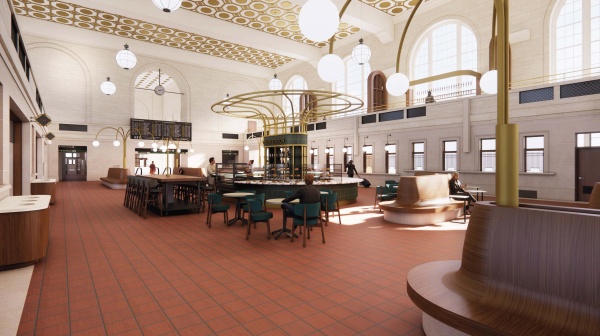
Connecticut and New Haven officials have announced a $24.8 million modernization of Union Station. The state-funded project includes:
- $9.1 million for exterior and parking garage repairs.
- $15.7 million for interior improvements.
- Renovated restrooms, hallways, flooring, ceilings, lighting, utilities, and common areas.
- Additional family restrooms and a wellness room.
- New retail and food service space.
- A central atrium bar and café.
- A mezzanine-level bar and lounge area.
- Expanded seating and upgraded passenger areas.
Union Station serves nearly four million passengers annually. The improvements are intended to make the station more than a transfer point. The objective is a stronger transit hub with retail, dining, and community activity.
A formal Request for Interest (RFI) is open for prospective food, retail, service, kiosk, cart, and pop-up operators. Vendor applications are due January 29, 2027.
For small businesses, this is a planning opportunity. Operators should:
- Review the RFI requirements before applying.
- Prepare a realistic startup and operating budget.
- Project sales by daypart and passenger volume.
- Separate build-out costs from recurring operating expenses.
- Confirm sales tax, payroll, insurance, licensing, and vendor requirements.
- Maintain monthly bookkeeping before opening, not after the first busy season.
Transit-oriented retail can be attractive. It can also be expensive. A polished concept still requires disciplined cash-flow analysis.
Inclusive Growth Roadmap Prioritizes Affordability and Local Business!
The Yale-backed Center for Inclusive Growth is developing an economic development roadmap focused on affordable living, workforce readiness, financial access, local purchasing, and small-business support.
The Center’s stated mission is to connect residents, institutions, entrepreneurs, and community organizations around practical economic opportunities. Its work includes support for local businesses and initiatives such as BUY NEW HAVEN, which encourages anchor institutions and larger organizations to purchase from New Haven businesses.
The economic value is straightforward. When institutions buy locally, more revenue can circulate through neighborhood businesses. When residents can afford housing and basic needs, businesses may have a stronger customer base and a more stable workforce.
Small-business owners should use this environment strategically:
- Track revenue by customer type and service line.
- Measure the effect of institutional contracts on margins.
- Document marketing, delivery, software, and professional-service costs.
- Review estimated tax payments as revenue changes.
- Use year-round bookkeeping to identify declining sales early.
A roadmap is not a substitute for a cash-flow statement. It is a reason to keep one.

Yale Presents Two Hill-Connected Development Priorities!
Yale is pitching two significant projects connected to the Hill and the surrounding medical and research district:
- A Biomedical Imaging Institute.
- A large research facility intended to expand advanced institutional and scientific activity.
The Biomedical Imaging Institute brings together imaging research, data science, and specialized PET and MR capabilities. Its work is connected to Yale’s medical campus, which borders the Hill neighborhood and includes existing imaging facilities and research infrastructure.
Residents are asking for more direct consultation and clear local hiring commitments. Those requests are relevant to economic development. Large institutions can affect neighborhood traffic, housing demand, construction activity, and commercial opportunities for years.
Community engagement should address specific questions:
- Which construction and service contracts will be available to local firms?
- What workforce training or apprenticeship pathways will be offered?
- How will pedestrian, parking, and traffic impacts be managed?
- What local hiring targets will be measured?
- How will nearby residents and businesses receive project updates?
New Haven’s innovation economy is growing. The benefits should be documented, measurable, and accessible to the neighborhoods closest to the work.
The city has also approved a 12-month moratorium on new AI data centers while land-use impacts are studied. That measure is part of the larger conversation about infrastructure capacity, property use, energy demand, and long-term planning.
Fair Haven Businesses Report Pressure as Community Fear Affects Customer Activity!
Small businesses in Fair Haven are reporting declining sales amid community fear surrounding recent ICE enforcement activity. This issue should be discussed with care and professionalism. The immediate business concern is customer activity, employee attendance, operating stability, and access to support.
No business should have to guess whether a temporary sales decline is seasonal, economic, construction-related, or connected to reduced neighborhood activity. Owners should document the facts without making assumptions.
Use these steps:
- Compare weekly sales with the same period last year.
- Track foot traffic, cancellations, delivery volume, and average transaction size.
- Record unusual disruptions in a private operating log.
- Communicate clearly with employees about scheduling and available support.
- Contact the City of New Haven’s business resources for assistance with planning, permitting, and referrals.
- Connect with neighborhood business networks and community organizations.
Businesses may also review payment schedules, inventory levels, payroll hours, and discretionary spending. A business with shifting revenue may need a revised estimated tax strategy. It may also need a short-term cash reserve plan.
The City of New Haven business resources page and the Greater New Haven business directory provide useful starting points. Local markets and neighborhood events may also help maintain customer connections, including the Fair Haven Farmers Market.
Union Square Advances Near the Transit Corridor!
The Housing Authority of New Haven is advancing the first phase of Union Square, a planned mixed-income, mixed-use, transit-oriented development near Union Station.
The authority did not receive the hoped-for $26 million federal Choice Neighborhoods Implementation Grant. It is continuing with the project and plans to seek federal funding again. Phase 1 includes approximately 541 apartments, retail and commercial space, and related parking across three buildings.
The larger Union Square plan is expected to include approximately 2,490 apartments over time. The first phase is designed to create a gateway near the station and coordinate with other transit-oriented development in the area.
The authority is pursuing additional financing, including Low-Income Housing Tax Credits (LIHTCs). For local businesses, the project may create opportunities in construction, property management, maintenance, food service, transportation, cleaning, professional services, and neighborhood retail.
Businesses preparing to participate should:
- Obtain and retain vendor agreements.
- Collect Forms W-9 from contractors and service providers.
- Track labor, materials, mileage, equipment, and subcontractor expenses.
- Reconcile bank activity monthly.
- Review insurance and licensing requirements.
- Prepare for Form 1099-NEC reporting where applicable.
Construction activity can produce revenue quickly. It can also produce paperwork quickly. Use both a calendar and a ledger.
What New Haven Residents and Business Owners Should Do Now!
New Haven’s growth story includes laboratories, research facilities, transit improvements, housing, retail, and neighborhood commerce. Each project can create opportunity, but each also introduces financial decisions.
Before the final quarter of 2026 closes, business owners should:
- Reconcile bookkeeping through September.
- Review year-to-date profit and loss statements.
- Estimate federal and Connecticut tax obligations.
- Check contractor documentation and Form W-9 files.
- Identify equipment, improvements, and other capital purchases.
- Review payroll and independent-contractor classifications.
- Build a 2027 operating budget using conservative revenue assumptions.
Jose’s Tax Service provides personalized tax preparation, bookkeeping, tax planning, business support, and federal and Connecticut e-filing for individuals and small businesses. Review the Small Business Learning Center for bookkeeping and compliance tools, then book a virtual or in-person appointment for individualized guidance.
Do not wait for tax season to discover that a development boom, a sales decline, or a contractor file has changed your tax position. Schedule a year-round planning appointment with Jose’s Tax Service.
Sources and official resources
- Unilever: Investing $270 million in a Global Innovation Center in New Haven
- Hartford Business Journal: Unilever innovation center and state infrastructure support
- Connecticut Governor’s Office: New Haven Union Station modernization and retail opportunities
- Union Station New Haven: Retail opportunities and Request for Interest
- Center for Inclusive Growth New Haven
- Yale Biomedical Imaging Institute
- City of New Haven: Business resources
- Inner-City News: Union Square federal grant application and Phase 1
- Inner-City News: 12-month pause on data center development
Category: News | Tags: New Haven news, local economy, CT updates, community
Leave a Reply
You must be logged in to post a comment.