
7 Mistakes You’re Making with Your 2026 Taxes (and How to Maximize Your Tax Refund)
NEW HAVEN, CT – Jose’s Tax Service – March 23, 2026
Tax season is currently in full swing, and for many residents in New Haven, the pressure to file quickly often leads to expensive oversights. As the CEO of Jose’s Tax Service, I, Jose’ Morales, see the same errors year after year that result in delayed refunds, unnecessary IRS correspondence, and missed opportunities to keep more money in your pocket.
With the 2026 tax year introducing specific legislative updates, including new provisions for overtime pay and tip income, the complexity of filing has increased. To maximize your tax refund and ensure compliance, you must navigate these changes with precision. Whether you are searching for tax preparation New Haven or looking for a concierge tax pro, understanding these seven common pitfalls is the first step toward a successful filing season.
1. Filing Before All Official Tax Documents Arrive!
One of the most frequent mistakes taxpayers make is rushing to file in January or February before receiving all required documentation. Submitting a return based on a final paystub rather than an official Form W-2 (Wage and Tax Statement) often leads to discrepancies. The IRS computer systems automatically match the income reported on your return against the data provided by employers and financial institutions.
If you file before receiving all Form 1099s, including 1099-INT for interest, 1099-DIV for dividends, or 1099-K for third-party platform payments, your return will likely be flagged for a "mismatch." This results in a frozen refund and a manual review process that can take months to resolve.
How to fix it: Wait until you have a complete digital or physical file of all 2025 income documents. You should also log into your IRS Online Account to view your tax records and ensure no documents are missing. If you are unsure if you have everything, our team at Jose’s Tax Service can help you verify your documentation before submission.
2. Selecting the Incorrect Filing Status!
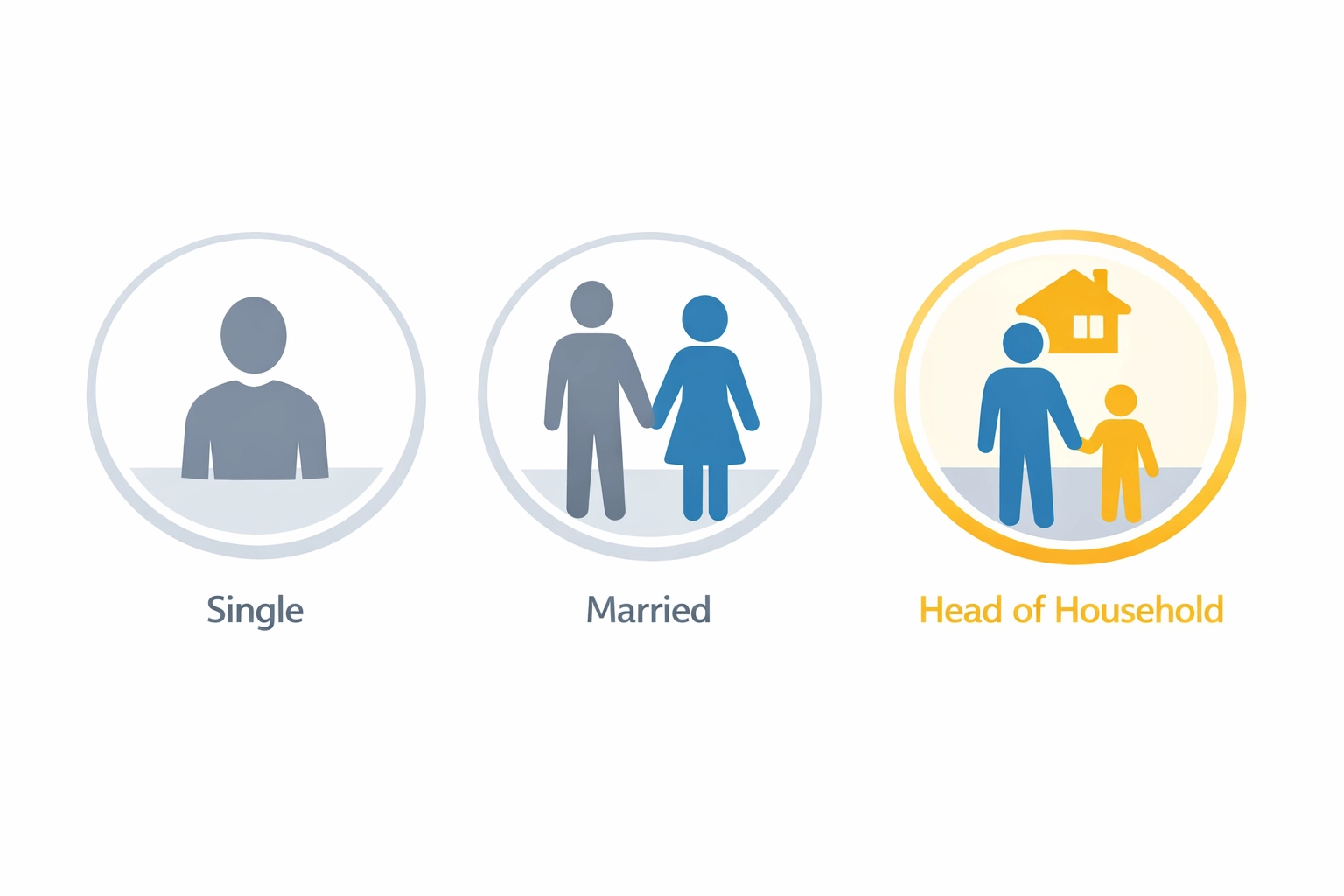
Your filing status is the foundation of your tax return. It determines your standard deduction amount, your tax brackets, and your eligibility for various credits. Many taxpayers default to "Single" or "Married Filing Separately" without realizing they may qualify for "Head of Household" (HOH) status, which offers a significantly higher standard deduction and more favorable tax rates.
To qualify for Head of Household, you must be unmarried (or "considered unmarried") on the last day of the year, have paid more than half the cost of keeping up a home for the year, and have a qualifying person living with you for more than half the year. Misclaiming this status is a major red flag for the IRS and can lead to a full audit of your dependents.
How to fix it: If you experienced a life change in 2025, such as a divorce, a separation, or becoming the primary support for a parent, re-evaluate your status. Use the IRS Interactive Tax Assistant or schedule your tax appointment with ease to have a professional determine the most advantageous status for your specific situation.
3. Overlooking New 2026 Deductions and Credits!
The 2026 tax landscape has shifted. If you are filing the same way you did three years ago, you are likely leaving money on the table. For the 2026 filing season, there are specific nuances regarding the treatment of overtime pay and certain tip income that were not present in previous years. Furthermore, many taxpayers fail to maximize the Earned Income Tax Credit (EITC) or the Child Tax Credit (CTC) because they assume they earn too much, not realizing that income thresholds and phase-out rules are adjusted annually for inflation.
Additionally, education-related credits like the American Opportunity Tax Credit (AOTC) are frequently underclaimed. If you or a dependent are pursuing higher education, you may be eligible for a credit of up to $2,500 per student.
How to fix it: Do not assume your tax situation is "simple." A concierge tax pro will review your entire financial profile to identify credits for energy-efficient home improvements, student loan interest, and teacher expenses. Review our small business learning center for more details on how these credits apply to various income levels.
4. Inaccurate Reporting of "Side-Hustle" and 1099-K Income!
With the rise of the gig economy, more New Haven residents are receiving Form 1099-K from apps like Venmo, PayPal, and CashApp. Failing to report this income is a guaranteed way to receive an IRS notice. Even if you do not receive a form, any income earned from services, sales, or rentals must be reported on your return.
However, the mistake often goes the other way as well: reporting the gross amount without deducting legitimate business expenses. If you earned $10,000 in side-gig income but spent $3,000 on supplies and travel, you should only be taxed on the $7,000 profit.
How to fix it: Keep meticulous records of all income and expenses. If you are a freelancer or small business owner, check out our tax preparation service in New Haven to ensure you are utilizing Schedule C (Profit or Loss from Business) correctly to reduce your taxable income.
5. Typos in Social Security Numbers and Names!
It sounds elementary, but the IRS rejects thousands of returns every year due to simple data entry errors. A misspelled name or a single transposed digit in a Social Security Number (SSN) or Individual Taxpayer Identification Number (ITIN) will cause the IRS systems to kick the return back immediately.
This is particularly common for taxpayers who have recently married or divorced and changed their names but failed to notify the Social Security Administration (SSA). The name on your tax return must match the name on file with the SSA exactly.
How to fix it: Physically look at the Social Security cards for yourself, your spouse, and all dependents while entering data. Do not rely on memory. If you have had a name change, ensure it is processed through the SSA before you file your 2026 return.
6. Entering Incorrect Bank Routing or Account Numbers!
If you are expecting a refund, direct deposit is the fastest and safest method to receive it. However, if you enter the wrong routing or account number, the consequences are severe. If the incorrect numbers belong to someone else’s account, and the bank accepts the deposit, the IRS cannot assist you in recovering those funds. If the bank rejects the deposit, the IRS will eventually issue a paper check, but this can add four to six weeks to your wait time.
How to fix it: Double-check, then triple-check, your banking information. Ensure you are distinguishing between the routing number (usually the first nine digits on the bottom left of your check) and your account number. If you are worried about the security of your data, you can use our e-signing portal to safely review and authorize your return details.
7. Missing the Signature and the Deadline!
An unsigned tax return is treated as if it were never filed. For those filing paper returns, both spouses must sign a joint return. For those e-filing, you must use a Personal Identification Number (PIN) or provide your previous year's Adjusted Gross Income (AGI) to "sign" the return electronically.
Furthermore, many taxpayers confuse the filing extension with a payment extension. Even if you file Form 4868 for an automatic six-month extension to file your paperwork, any taxes owed are still due by April 15, 2026. Failure to pay by this date results in late-payment penalties and interest charges that accrue daily.
How to fix it: File as early as possible once you have all your documents. If you cannot pay the full amount owed, file anyway to avoid the "failure-to-file" penalty, which is much higher than the "failure-to-pay" penalty. You can then set up a payment plan or request a quote to see how we can help you manage IRS debt.
Why a Concierge Tax Pro Makes the Difference
At Jose’s Tax Service, we believe that tax preparation New Haven should be more than just data entry. It should be a strategic look at your financial health. A concierge tax pro doesn't just look at what happened last year; we look at how to position you for the future.
Tax software often misses the nuances of local New Haven tax regulations or specific industry deductions. By working with a professional, you gain an advocate who understands the Internal Revenue Code (IRC) and can defend your deductions if the IRS ever asks questions.
Final Checklist for 2026 Success
Before you submit your return, run through this final checklist to maximize your tax refund:
- Document Verification: Do I have every W-2 and 1099?
- Identity Check: Are all SSNs and names identical to the cards?
- Status Check: Am I filing in the most advantageous category?
- New Laws: Have I accounted for 2026-specific income exclusions or deductions?
- Accuracy: Did I double-check my bank account and routing numbers?
- Signature: Is the return signed and dated (or PIN entered)?
Don't let simple mistakes shrink your refund or trigger an audit. If you’re ready for a professional, stress-free tax experience, contact us today or visit our blog for more tips on staying ahead of the IRS.
Jose’ Morales
CEO, Jose's Tax Service
New Haven, CT
Disclaimer: This information is for educational purposes. For specific advice regarding your tax situation, please consult with a qualified tax professional.

Leave a Reply
You must be logged in to post a comment.