
Your Quick-Start Guide to 2026 Side Hustle Taxes: Do This First
NEW HAVEN, CT – JOSE’S TAX SERVICE – MARCH 18, 2026
The gig economy is no longer a temporary trend; it is a permanent fixture of the American workforce. Whether you are driving for a ride-share app, selling handmade goods on Etsy, or consulting on the side, your "side hustle" is a business in the eyes of the Internal Revenue Service (IRS). As we navigate the 2026 tax landscape, specific regulatory changes and reporting thresholds have shifted. Failure to adapt to these changes can result in significant penalties, interest, and missed opportunities to maximize tax refund potential.
This guide provides the technical framework necessary for side hustlers to organize their finances and meet federal and state obligations. If you are seeking a concierge tax pro to handle these complexities, professional tax preparation in New Haven is available to ensure your filings are accurate and optimized.
1. Identify Your Taxable Status Immediately!
The first step in side hustle tax management is determining if your activity constitutes a business or a hobby. The IRS distinguishes between the two based on your intent to make a profit. If you earned a net profit of $400 or more during the 2025-2026 period, you are required to report this income and pay Self-Employment (SE) tax.
The $400 Threshold Rule:
If your net earnings (total income minus allowable business expenses) exceed $400, you must file Schedule SE (Form 1040) to calculate your Social Security and Medicare taxes. Even if you do not receive an official tax form from a client or platform, you are legally obligated to report all income.
The 2026 1099 Reporting Change:
It is critical to note that for the 2026 tax year, the reporting threshold for businesses issuing Form 1099-NEC (Nonemployee Compensation) or Form 1099-MISC has been adjusted. Businesses are generally only required to issue these forms if they paid you $2,000 or more during the year. This is a significant increase from previous years. Do not assume that a lack of a 1099 form means the income is tax-free. Use your own records to track every dollar earned.

2. Separate Your Finances Now!
One of the most common errors made by side hustlers is the commingling of personal and business funds. This practice complicates the audit process and makes it difficult to identify deductible expenses.
Required Actions:
- Open a Dedicated Business Account: Use this account exclusively for side hustle income and expenses.
- Use Dedicated Payment Methods: Assign a specific credit or debit card for business purchases only.
- Implement Digital Tracking: Utilize accounting software or spreadsheets to log transactions in real-time.
By maintaining clear separation, you simplify the process for your tax planning sessions and provide a clear paper trail should the IRS request documentation.
3. Calculate and Pay Quarterly Estimated Taxes!
Unlike traditional W-2 employees, side hustlers do not have taxes withheld from their paychecks. The United States operates on a "pay-as-you-go" system. If you expect to owe $1,000 or more in taxes for the year, you must make quarterly estimated tax payments using Form 1040-ES.
2026 Deadlines for Estimated Payments:
- Q1 (Jan 1 – March 31): Due April 15, 2026
- Q2 (April 1 – May 31): Due June 15, 2026
- Q3 (June 1 – Aug 31): Due Sept 15, 2026
- Q4 (Sept 1 – Dec 31): Due Jan 15, 2027
Failure to make these payments or underpaying can lead to "underpayment of estimated tax" penalties. To avoid this, aim to pay at least 90% of your current year’s tax liability or 100% of the tax shown on your prior year’s return.
4. Categorize Deductions to Maximize Tax Refund!
To minimize your taxable income, you must accurately track "ordinary and necessary" business expenses. These deductions are subtracted from your gross income on Schedule C (Form 1040).
Common Side Hustle Deductions include:
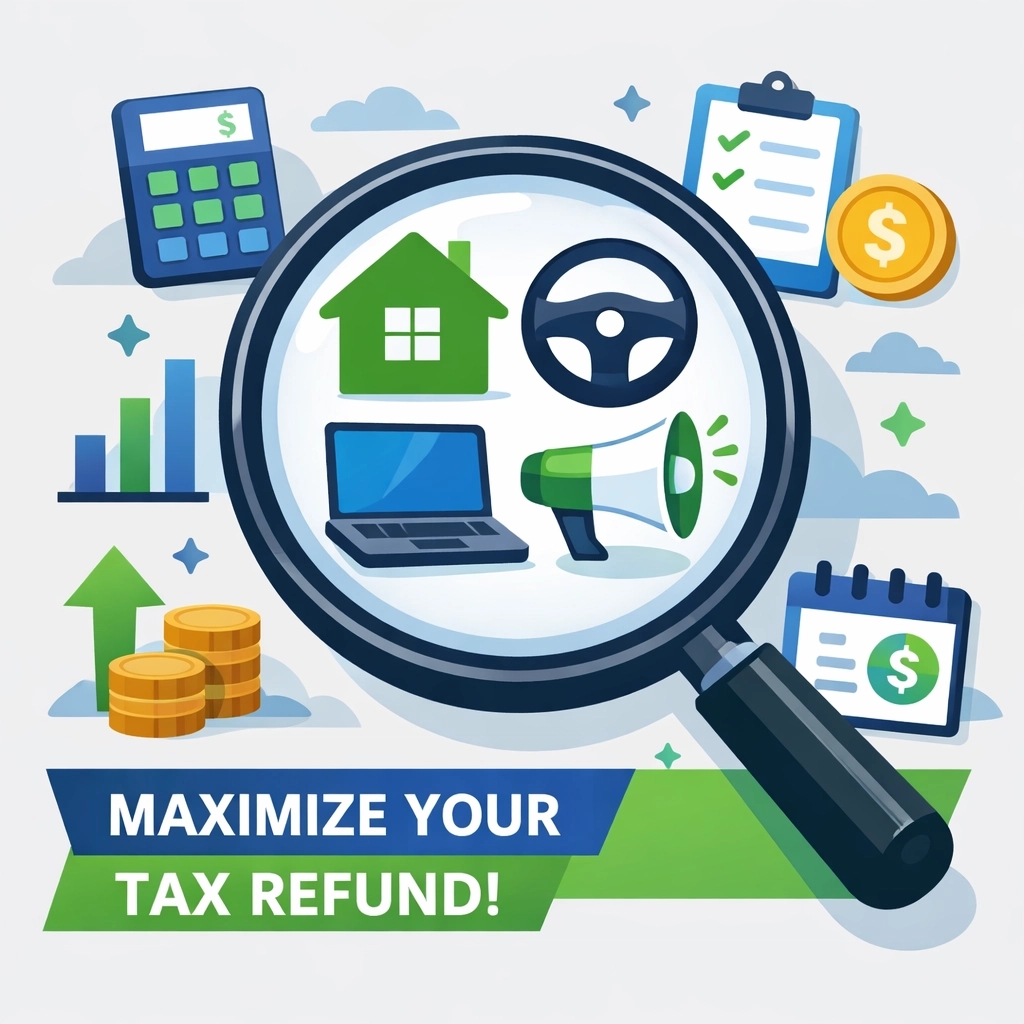
- Home Office Deduction: If you use a portion of your home regularly and exclusively for business, you may deduct a portion of your rent, mortgage interest, utilities, and insurance. You can use the simplified method ($5 per square foot, up to 300 square feet).
- Mileage and Vehicle Expenses: You may choose between the standard mileage rate (set annually by the IRS) or the actual expense method (gas, oil, repairs, insurance). Accurate logs are mandatory.
- Equipment and Supplies: Computers, software, specialized tools, and office supplies are deductible.
- Marketing and Advertising: Costs for social media ads, website hosting, and business cards are fully deductible.
- Professional Services: Fees paid to a concierge tax pro for tax preparation in New Haven are often deductible as a business expense.
5. Understand the Self-Employment Tax Reality!
When you work for an employer, they pay half of your Social Security and Medicare taxes (7.65%), and you pay the other half. When you are self-employed, you are responsible for both portions, totaling 15.3%.
- Social Security: 12.4% on earnings up to the annual wage limit.
- Medicare: 2.9% on all net earnings.
You are permitted to deduct 50% of your self-employment tax when calculating your adjusted gross income (AGI) on Form 1040. This deduction reduces your overall income tax but does not reduce the self-employment tax itself.
6. Master the Essential Tax Forms!
To file accurately, you must become familiar with the following IRS documents:
- Form 1040: Your main individual income tax return.
- Schedule C (Profit or Loss from Business): Used to report income and expenses.
- Schedule SE (Self-Employment Tax): Used to calculate the 15.3% tax.
- Form 8829: Used for the home office deduction (if not using the simplified method).
- 1099-K: If you received payments through third-party networks (like Venmo or PayPal) that exceed the reporting threshold, you will receive this form.
Always double-check that the income reported on your 1099 forms matches the income you enter on Schedule C. Discrepancies often trigger automated IRS notices and delays in processing.
7. Documentation Requirements and Record Retention!
The burden of proof for all deductions lies with the taxpayer. The IRS recommends keeping records for at least three years from the date you filed your original return.
Maintain the following records:
- Receipts (digital or physical) for all purchases over $75.
- Bank and credit card statements.
- Invoices and proof of payment.
- Mileage logs with dates, destinations, and business purposes.
- Utility bills if claiming a home office.
Digital record-keeping is highly encouraged. Scanning receipts and storing them in a secure cloud environment prevents loss due to physical damage and allows for easy sharing with your tax professional.
8. Why Consult a Concierge Tax Pro in New Haven?
Tax laws for self-employed individuals are subject to frequent changes. For instance, the transition to the $2,000 threshold for 1099-NEC forms in 2026 requires a more proactive approach to bookkeeping. Relying on "do-it-yourself" software often leads to missed deductions or improper classification of income.
At Jose's Tax Service, we provide specialized support for side hustlers and small business owners. Our goal is to help you navigate the complexities of the tax code to maximize tax refund opportunities and ensure 100% compliance with federal and Connecticut state laws.
If you have questions regarding your specific situation, you can schedule your tax appointment with ease to speak with a professional.

Summary Checklist for 2026:
- Verify if your net profit exceeds the $400 threshold.
- Review all bank statements for income not reported on 1099s.
- Calculate and submit the next quarterly estimated tax payment via Form 1040-ES.
- Total all mileage and home office expenses.
- Ensure all business expenses were paid from a dedicated account.
- Book a consultation for professional tax planning before the deadline.
Proper preparation is the only way to avoid the stress of tax season. By treating your side hustle as a professional enterprise from day one, you protect your earnings and set the stage for future financial growth.
Disclaimer: This information is for educational purposes and does not constitute formal legal or tax advice. For specific guidance regarding your tax liability, please contact a qualified tax professional.
Contact Jose's Tax Service today for expert tax preparation in New Haven.
Date: March 18, 2026
Location: New Haven, CT
Organization: Jose's Tax Service

Leave a Reply
You must be logged in to post a comment.