
Top 5 Tax Strategies for Self-Employed Individuals in 2026
Being your own boss in New Haven comes with incredible freedom: but let's be real, tax season can feel like a different story. If you're self-employed, you already know that Uncle Sam treats you differently than your W-2 friends. The good news? The 2026 tax year brings some powerful strategies that can put serious money back in your pocket.
At Jose's Tax Service, we work with dozens of New Haven entrepreneurs, freelancers, and small business owners every season. We've seen firsthand what works: and what leaves money on the table. Here are the top five tax strategies you need to know right now.
Strategy #1: Consider the S Corporation Structure to Slash Self-Employment Tax
Here's something most self-employed folks don't realize until it's too late: you're paying double the Social Security and Medicare taxes that employees pay. The self-employment tax rate sits at 15.3% on your net earnings, and it adds up fast.
Enter the S Corporation election. This isn't just for "big businesses": it can work for solo entrepreneurs too. When you operate as an S-Corp, you split your income into two buckets: reasonable W-2 wages (which get hit with that 15.3% tax) and distributions (which don't).
Let's break down a real example. Say your New Haven consulting business nets $150,000 this year. As a sole proprietor, you'd pay roughly $22,950 in self-employment tax. But if you elect S-Corp status, pay yourself an $80,000 salary, and take $70,000 as distributions, your self-employment tax drops to about $12,240. That's a $10,710 savings: enough to upgrade your equipment, invest in marketing, or finally take that vacation.
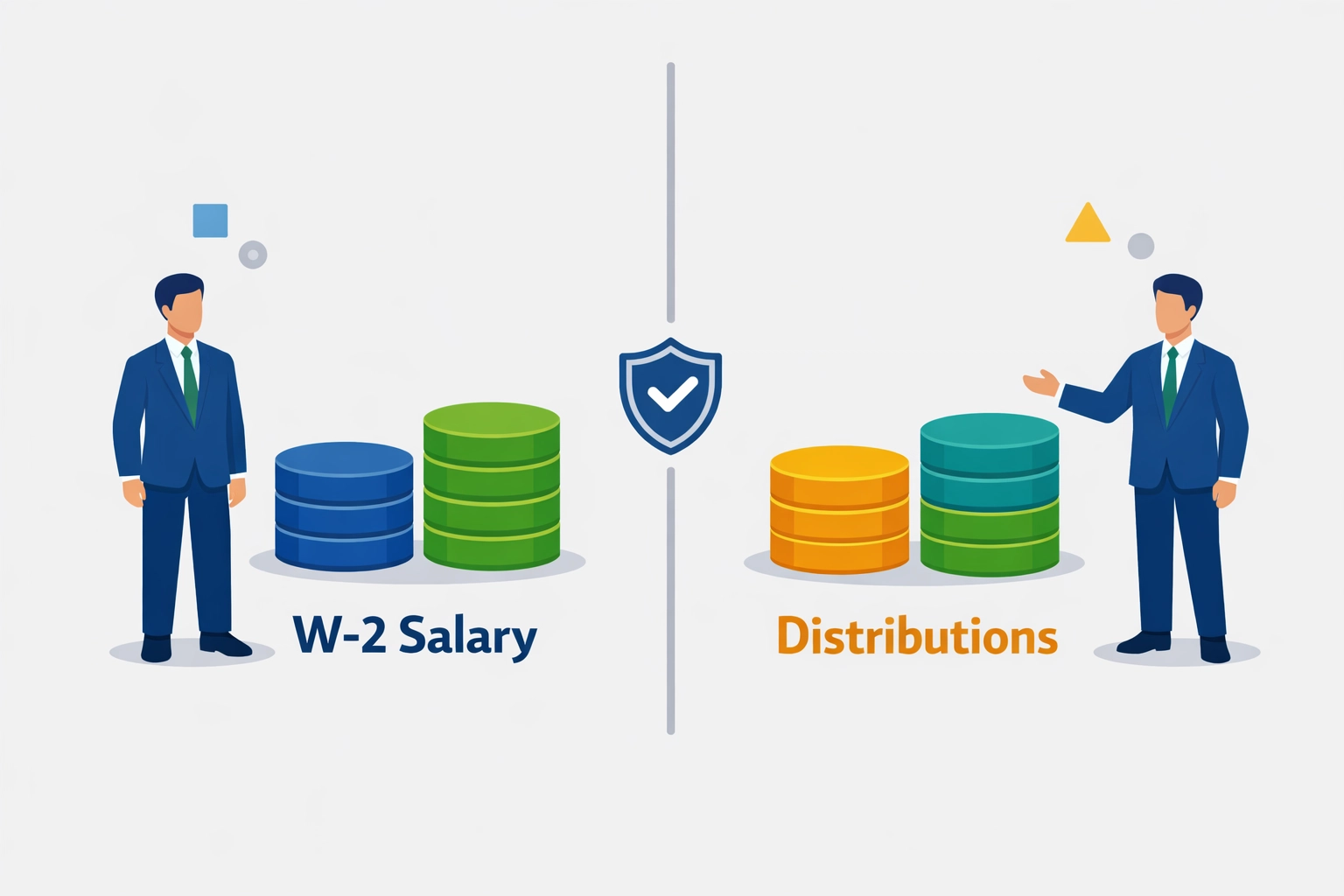
The catch? You need to pay yourself a "reasonable salary" for the work you do. The IRS watches this closely. That's where working with a tax pro makes all the difference. We help New Haven business owners find that sweet spot between tax savings and IRS compliance.
Important note: The 2026 Social Security wage base increased to $184,500. Track this threshold carefully when calculating your self-employment taxes.
Strategy #2: Maximize Your Qualified Business Income Deduction
The Qualified Business Income (QBI) deduction just got better for 2026, and it's now permanent. This allows eligible self-employed individuals to deduct up to 20% of their qualified business income.
For 2026, the phaseout limits increased to $70,000 for single filers and $150,000 for married couples filing jointly. Even better? There's now a minimum $400 deduction if your business earns at least $1,000 in qualified income. That's a game-changer for part-time freelancers and side hustlers.
Here's what this means in dollars and cents: if you're a New Haven graphic designer earning $60,000 in qualified business income (and you're under the phaseout threshold), you could deduct $12,000 right off the top. At a 24% tax bracket, that's $2,880 back in your pocket.
Not every type of income qualifies, and the rules can get complex depending on your business type and income level. We calculate this automatically for our clients: it's one less thing to worry about during tax season.
Strategy #3: Fund Your Retirement and Cut Your Tax Bill
Self-employed retirement plans are one of the most overlooked tax strategies out there. While your W-2 friends are limited to their employer's 401(k), you've got options like SEP IRAs that let you contribute significantly more.
For 2026, you can contribute up to 25% of your net self-employment earnings to a SEP IRA, with a maximum contribution of $69,000. These contributions are tax-deferred, meaning they reduce your taxable income today while building your retirement nest egg.

Let's say you're a New Haven contractor earning $120,000 in net self-employment income. You could contribute up to $30,000 to your SEP IRA, potentially saving $7,200 to $11,100 in taxes (depending on your bracket). That's real money working for your future instead of going to taxes.
Other options include Solo 401(k)s and SIMPLE IRAs. Each has different contribution limits and rules. At Jose's Tax Service, we review your specific situation to recommend the retirement plan that maximizes both your tax savings and your long-term financial security.
Strategy #4: Pair Your Business With Rental Real Estate
This strategy isn't for everyone, but it's incredibly powerful if you're already considering investment property or own rental real estate. Combining your operating business income with rental property creates built-in tax offsets through depreciation and other rental expenses.
Real estate offers paper losses through depreciation: even when the property is cash-flowing positively. Cost segregation studies can accelerate these deductions, creating losses that offset your business profits without impacting your actual cash flow.
For New Haven business owners, this can be particularly attractive. The local rental market remains strong, and you don't need to become a full-time landlord to benefit. Even one well-managed rental property can provide significant tax advantages.
The key is proper planning and documentation. Rental real estate comes with specific tax rules, passive activity limitations, and recordkeeping requirements. We help our clients navigate these waters to ensure they're getting maximum benefit while staying fully compliant.
Strategy #5: Deduct Every Legitimate Business Expense
This sounds obvious, but you'd be surprised how many self-employed New Haven residents leave deductions on the table. Every legitimate business expense reduces both your income tax and your self-employment tax.
Don't overlook these commonly missed deductions:
Home Office Deduction: If you use part of your home exclusively for business, you can deduct a portion of your rent or mortgage, utilities, insurance, and maintenance. For 2026, the simplified method allows $5 per square foot up to 300 square feet: that's up to $1,500 in deductions with minimal paperwork.
Vehicle Expenses: Whether you use the standard mileage rate ($0.70 per mile for 2026) or actual expenses, your business driving is deductible. Keep detailed logs.
Health Insurance Premiums: Self-employed individuals can deduct health insurance premiums for themselves and their families as an adjustment to income: you don't even need to itemize.
Professional Development: Courses, conferences, books, and coaching related to your business are fully deductible.
Technology and Equipment: Computers, software, phones, and other necessary equipment can often be deducted immediately under Section 179 rules.
Marketing and Advertising: Your website, business cards, social media ads, and promotional materials all count.

The biggest mistake? Not tracking expenses throughout the year. By tax time, you've forgotten half of what you spent. Set up a simple system now: whether it's a dedicated business credit card, accounting software, or even a spreadsheet. Your future self will thank you.
Don't Forget Estimated Quarterly Taxes
Here's the reality check: self-employed individuals need to pay estimated taxes quarterly. Miss these payments, and you'll face penalties and interest: even if you pay your full tax bill by the April deadline.
For 2026, your quarterly payment deadlines are April 15, June 16, September 15, and January 15, 2027. Calculate 90% of your expected tax liability and divide by four. If your income fluctuates, you can adjust payments each quarter using the annualized income method.
How Jose's Tax Service Makes This Easy
Look, we get it. You started your business to do what you love: not to become a tax expert. That's where we come in.
At Jose's Tax Service in New Haven, we provide personalized tax preparation and planning for self-employed individuals and small business owners. We don't just fill out forms: we strategize with you throughout the year to minimize your tax bill legally and ethically.
Here's what makes us different:
- $0 Upfront Payment: Get your taxes done professionally without breaking the bank. We believe everyone deserves quality tax preparation.
- Year-Round Support: Tax planning isn't a once-a-year thing. We're here when questions come up.
- Local Expertise: We understand New Haven's business community and state tax requirements.
- Personalized Strategies: Cookie-cutter advice doesn't work. We tailor our recommendations to your specific business and goals.
Whether you're a freelancer just starting out or an established business owner looking to optimize your tax situation, we've got your back.
Take Action Now
The 2026 tax season is here, and the strategies you implement today will impact your bottom line for years to come. Don't wait until April to think about taxes: proactive planning is where the real savings happen.
Ready to keep more of what you earn? Contact Jose's Tax Service today. Let's review your situation and create a tax strategy that works specifically for your New Haven business. Because when tax season rolls around, you should be focused on growing your business: not stressing over your tax bill.
Visit us at Jose's Tax Service or call to schedule your consultation. Your future self (and your bank account) will thank you.

Leave a Reply
You must be logged in to post a comment.