
The 2026 Child Tax Credit: What New Haven Families Need to Know
New Haven, CT – January 30, 2026 : The Child Tax Credit (CTC) has received significant updates for the 2026 tax year following the passage of the One Big Beautiful Bill Act in 2025. New Haven families with qualifying children can now claim $2,200 per child under age 17, with $1,700 of that amount being fully refundable.
This represents a permanent expansion of the credit, with built-in inflation adjustments that will continue to increase the benefit in future years. Understanding these changes can put hundreds or thousands of dollars back in your pocket this tax season.
What Changed for 2026!
The 2026 Child Tax Credit includes several key updates that directly impact Connecticut families:
Maximum Credit Amount: The credit increased from $2,000 in 2025 to $2,200 per qualifying child in 2026. This $200 increase applies automatically to all eligible families filing their 2026 returns.
Refundable Portion Expanded: The refundable amount rose from $1,600 to $1,700. This means you can receive up to $1,700 as a tax refund even if you owe zero federal taxes.
Permanent Status: Previous child tax credit expansions were set to expire. The One Big Beautiful Bill Act made these enhanced amounts permanent, providing long-term certainty for family tax planning.

Inflation Indexing Begins: Starting with the 2026 tax year, both the maximum credit and refundable portion will be adjusted annually for inflation. This ensures the credit maintains its purchasing power as living costs rise in New Haven and across Connecticut.
Who Qualifies for the 2026 Child Tax Credit
Eligibility requirements remain straightforward. Review these criteria to determine if your family qualifies:
Income Limits: Your modified adjusted gross income (MAGI) must fall below $200,000 for single filers or $400,000 for married couples filing jointly. These thresholds did not change from 2025.
Child Age Requirement: Your child must be under age 17 at the end of the tax year (December 31, 2026). A child who turns 17 during 2026 does not qualify for that year.
Relationship Test: The child must be your son, daughter, stepchild, foster child, sibling, stepsibling, or a descendant of any of these individuals.
Residency Requirement: The child must have lived with you for more than half of 2026. Temporary absences for school, medical care, or vacation count as time lived with you.
Support Test: The child cannot have provided more than half of their own financial support during 2026.
Social Security Number Requirement: Both you (and your spouse if filing jointly) and your qualifying child must have valid Social Security numbers issued before the due date of your 2026 tax return.
How the Credit Reduces Your Tax Bill
The Child Tax Credit operates as a dollar-for-dollar reduction of your federal tax liability. Understanding how this works helps you plan your finances throughout the year.
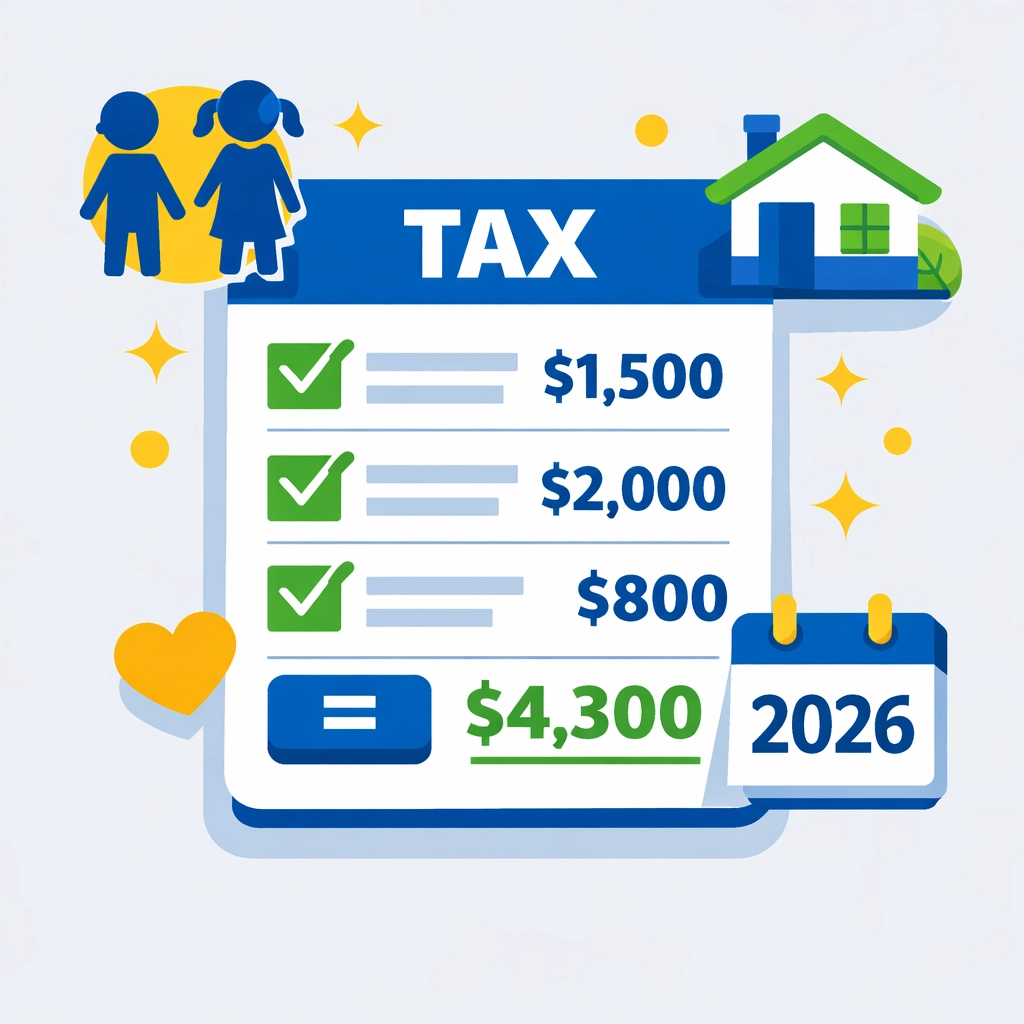
Direct Tax Reduction: If you calculate your 2026 tax bill at $3,500 and qualify for one child, the $2,200 credit reduces your bill to $1,300. With two qualifying children, the $4,400 credit reduces that same $3,500 bill to zero, with $900 potentially refundable.
Refundable Amount: The $1,700 refundable portion means families with little or no tax liability can still receive money back. If your calculated tax bill is $1,000 and you claim the $2,200 credit for one child, you owe nothing and receive a $1,700 refund.
Non-Refundable Portion: The remaining $500 per child ($2,200 minus $1,700) can only reduce your tax bill to zero. It cannot generate a refund by itself.
Calculate your potential benefit by reviewing your 2025 tax return. Estimate your 2026 income and tax liability, then apply the $2,200 per child credit to determine your expected savings.
Phase-Out Rules for Higher-Income Families
The credit begins to phase out once your income exceeds the threshold amounts. New Haven families with higher incomes should understand how this affects their benefit.
Phase-Out Begins: For single filers, the credit starts reducing when MAGI exceeds $200,000. For joint filers, phase-out begins at $400,000.
Reduction Rate: The credit decreases by $50 for each $1,000 of income above the threshold. A married couple earning $410,000 would see their credit reduced by $500 ($50 × 10).
Complete Phase-Out: The credit fully phases out at approximately $240,000 for single filers with one child, or $440,000 for joint filers with one child. Additional children extend the phase-out range.
Income planning strategies may help you stay below phase-out thresholds. Contributing to retirement accounts, Health Savings Accounts, or making other pre-tax deductions can reduce your MAGI.
How to Claim the Child Tax Credit on Your 2026 Return
Claiming the credit requires accurate completion of specific tax forms. Follow these steps when preparing your return:
Step 1: Gather Social Security numbers for yourself, your spouse (if filing jointly), and all qualifying children. These must be valid SSNs, not Individual Taxpayer Identification Numbers (ITINs).
Step 2: Complete IRS Schedule 8812 (Credits for Qualifying Children and Other Dependents). This form calculates your exact credit amount based on your income and number of qualifying children.
Step 3: Enter qualifying children's information on Form 1040, Line 2. List each child's name, SSN, and relationship to you.
Step 4: Transfer the calculated credit amount from Schedule 8812 to Form 1040, Line 19. This is where the credit reduces your tax liability.
Step 5: Double-check all SSNs match Social Security Administration records exactly. Mismatched or incorrect numbers will delay processing and may disqualify you from claiming the credit.
Step 6: File your return electronically with direct deposit information. This ensures fastest processing and refund delivery.
Common errors that delay credits include incorrect SSNs, claiming children who don't meet residency requirements, and miscalculating income phase-out amounts. Review your return carefully before filing.
Special Considerations for New Haven Families
Connecticut families face unique circumstances that may affect their Child Tax Credit eligibility and planning:
Divorced or Separated Parents: Only the custodial parent (the parent with whom the child lived for the greater part of 2026) can claim the Child Tax Credit. This rule applies even if the non-custodial parent claims the dependency exemption through Form 8332.
College Students: If your 16-year-old child graduated high school early and started college full-time in 2026, they still qualify as long as they're under 17 on December 31, 2026.
Multiple Jobs: New Haven families where both spouses work or one spouse works multiple jobs should adjust Form W-4 withholding to account for the credit. Under-withholding may lead to unexpected tax bills in April.
State Credit Coordination: Connecticut does not offer a separate state-level child tax credit. The federal credit does not affect your Connecticut state tax return directly.

Planning Ahead: 2027 and Beyond
The inflation adjustment feature means the Child Tax Credit will increase in future years. Strategic planning now can maximize your benefits:
Track Income Growth: If your income is approaching phase-out thresholds, consider tax-advantaged contributions to keep your MAGI below $200,000 (single) or $400,000 (joint).
Coordinate with Other Credits: The Child Tax Credit works alongside the Earned Income Tax Credit (EITC) and Child and Dependent Care Credit. Families may qualify for multiple benefits.
Review Annually: As credit amounts increase with inflation, your withholding may need adjustment. Review your W-4 each January to ensure proper tax planning throughout the year.
Document Everything: Maintain records proving residency, support, and relationship for each qualifying child. In the event of an IRS inquiry, proper documentation ensures quick resolution.
How Jose's Tax Service Can Help Your Family
Navigating child tax credit rules, phase-outs, and coordination with other benefits requires expertise. Jose's Tax Service specializes in family tax planning for New Haven residents.
Our team stays current with all federal tax law changes, including the 2026 Child Tax Credit updates. We review your specific situation to ensure you claim every dollar you're entitled to receive.
Family Tax Planning Services Include:
- Complete review of Child Tax Credit eligibility for all dependents
- Income planning strategies to maximize credit amounts
- Coordination with EITC, education credits, and dependent care benefits
- W-4 adjustment recommendations for optimal withholding
- Representation in case of IRS questions or audits
Schedule your appointment at Jose's Tax Service before the April 15 deadline. Early filers receive refunds faster and avoid last-minute stress.
File Early to Receive Your Refund Faster!
The IRS began accepting 2026 tax returns on January 27. Families expecting refunds from the Child Tax Credit should file as soon as possible.
Electronic filing with direct deposit typically results in refunds within 21 days. Paper returns may take 6-8 weeks to process. The IRS "Where's My Refund?" tool tracks your return status starting 24 hours after e-filing.
Returns claiming the Child Tax Credit or Earned Income Tax Credit face a statutory hold until mid-February. The IRS cannot issue these refunds before February 15, even if you file in January. However, early filing still ensures you're first in line once the hold period expires.
Don't leave money on the table. The 2026 Child Tax Credit puts $2,200 per child back in your pocket: money New Haven families can use for education, savings, or household expenses. Understanding the rules and filing correctly ensures you receive your full benefit.
Contact Jose's Tax Service today to schedule your family tax preparation appointment and maximize your 2026 refund.

Leave a Reply
You must be logged in to post a comment.