
Tax Planning Secrets Revealed: What New Haven Tax Pros Don't Want You to Know About the 2026 Changes
New Haven, CT – January 7, 2026 – While most tax professionals focus on standard deductions and basic compliance, sophisticated tax planning strategies for 2026 remain underutilized by Connecticut taxpayers. These advanced techniques can generate significant savings, but many preparers lack the expertise or incentive to implement them effectively.
Critical Property Tax Deadline Already Passed!
New Haven property owners should immediately verify their payment status. The second installment of 2025 property taxes became due January 1, 2026, with payment required by February 2, 2026. Properties with unpaid taxes will face delinquency status on February 3, 2026, triggering retroactive interest charges back to January 1.
Current New Haven mill rates for tax year 2025:
- Real Estate: 39.40 mills per $1,000 assessed value
- Personal Property: 39.40 mills per $1,000 assessed value
- Motor Vehicle: 32.46 mills per $1,000 assessed value
Most tax preparers focus solely on income tax obligations while overlooking property tax optimization strategies. Property owners can appeal assessments through March 31, 2026, potentially reducing future tax liability by thousands of dollars annually.

Estate Tax Trap Most Advisors Miss
Connecticut's estate tax structure creates a planning nightmare that catches even experienced professionals off-guard. While the federal estate tax exemption increases to $15 million per individual in 2026, Connecticut maintains its separate $15 million exemption with a critical flaw.
The Connecticut estate tax portability problem:
Unlike federal law, Connecticut does not allow married couples to combine unused exemptions between spouses. When the first spouse dies with an unused exemption, that amount disappears forever unless properly documented through specific legal structures.
This means a married couple with a $25 million estate could face Connecticut estate taxes on $10 million, despite having theoretical combined exemptions of $30 million. The 12% flat tax rate on amounts exceeding the exemption translates to $1.2 million in unnecessary state taxes.
Required action steps:
- Execute proper documentation before December 31, 2026
- File Connecticut Form 706CT within nine months of death
- Establish irrevocable trust structures to preserve exemptions
- Coordinate with federal Form 706 filing requirements
Sales Tax Strategy Hidden in Plain Sight
New Haven's 6.35% combined sales tax rate appears straightforward, but strategic timing can generate substantial savings for major purchases. Unlike neighboring municipalities with local sales tax additions, New Haven residents pay only the Connecticut state rate.
Business purchase timing optimization:
- Capital equipment purchases made in December 2025 qualify for Section 179 deductions in tax year 2025
- The same purchases made in January 2026 defer deduction benefits until tax year 2026
- Strategic timing can shift $100,000+ in taxable income between years
Many tax preparers fail to coordinate sales tax planning with income tax optimization, missing opportunities to reduce overall tax burden through purchase timing.

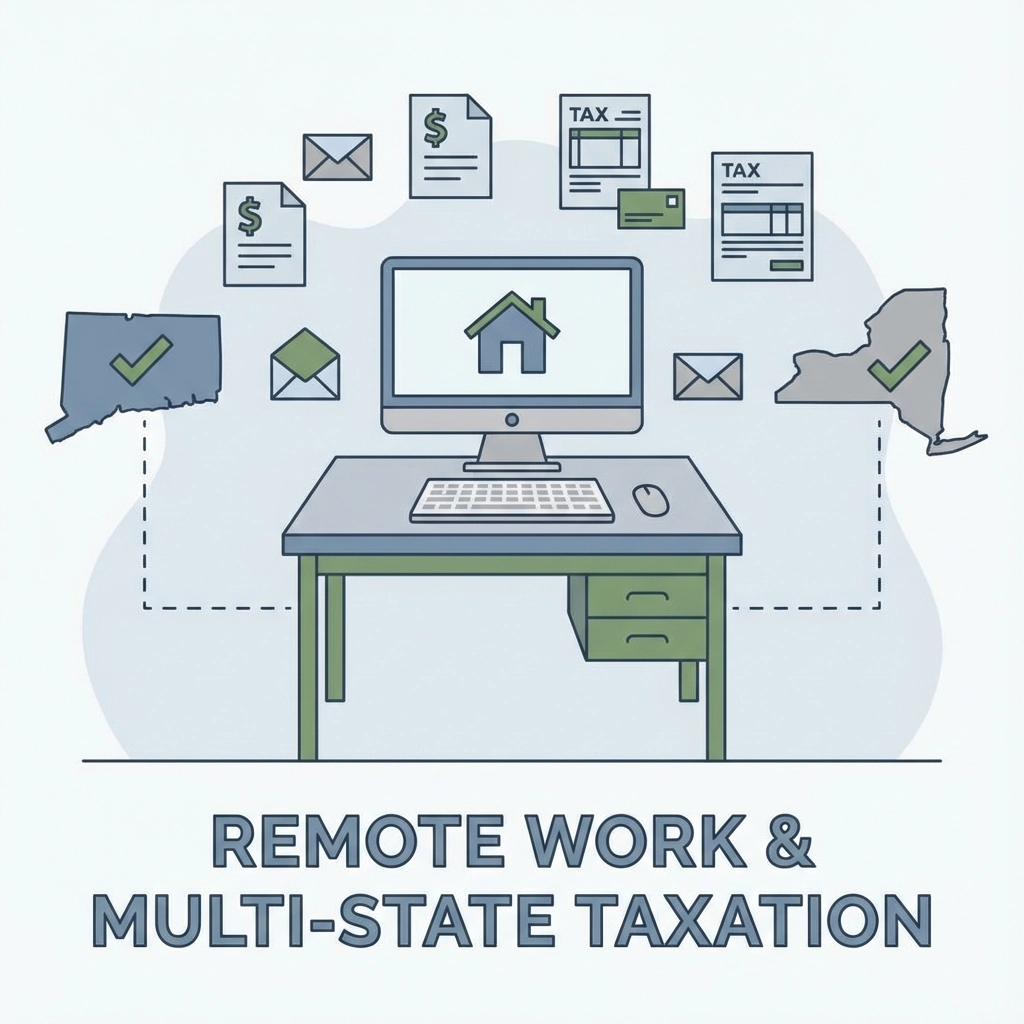
The Multi-State Income Allocation Loophole
Connecticut residents working in New York face complex allocation rules that most preparers handle incorrectly. The convenience of employer rule requires New York taxation of income earned while working remotely from Connecticut, unless specific exceptions apply.
Documentation requirements often overlooked:
- Employer-mandated home office designation letters
- Detailed telecommuting agreements specifying Connecticut work requirements
- Physical office space documentation and business necessity proof
- Client meeting logs demonstrating Connecticut business activity
Proper documentation can shift thousands of dollars in income from New York's higher tax rates to Connecticut's more favorable structure. Most preparers accept New York taxation without exploring available exceptions.
Advanced Retirement Account Strategies
The 2026 SECURE Act provisions create new opportunities for retirement account optimization that remain largely unexplored by typical tax preparation services.
Roth conversion ladder implementation:
- Convert traditional IRA amounts up to the top of your current tax bracket
- Pay current-year taxes on converted amounts
- Allow converted funds to grow tax-free in Roth accounts
- Withdraw Roth principal penalty-free after five years
This strategy works particularly well for Connecticut residents approaching retirement, as the state does not tax most retirement income. Converting funds during lower-income years minimizes total lifetime tax liability.

Required minimum distribution (RMD) charity optimization:
- Taxpayers age 70½ and older can transfer up to $105,000 annually from IRAs directly to qualified charities
- Qualified Charitable Distributions (QCDs) count toward RMD requirements without generating taxable income
- This strategy bypasses the standard deduction limitation on charitable giving
Most preparers suggest standard charitable deductions without exploring QCD benefits, potentially costing taxpayers thousands in unnecessary income taxes.
Small Business Entity Selection Errors
Connecticut's Pass-Through Entity Tax (PTET) election creates complex optimization scenarios that require careful analysis beyond basic tax preparation scope.
PTET election benefits:
- State and local tax deduction workaround for federal limitations
- Potential $10,000+ in additional federal deductions for qualifying businesses
- Partner/shareholder level tax credit offsetting Connecticut income tax liability
Entity structure optimization considerations:
- S-Corporation vs. LLC taxation election timing
- Connecticut Business Entity Tax coordination
- Multi-state business allocation advantages
- Employment tax minimization through reasonable salary planning
Standard tax preparation services typically file returns without evaluating entity structure optimization or PTET election benefits.
Timing Strategies for Investment Income
Connecticut's dividend and interest taxation creates opportunities for strategic income timing that most advisors ignore.
Municipal bond optimization:
- Connecticut municipal bonds generate triple tax-exempt income for state residents
- Out-of-state municipal bonds remain subject to Connecticut income tax
- Strategic portfolio allocation can eliminate state taxation on significant investment income
Capital gains harvesting techniques:
- Realize long-term capital losses to offset gains
- Coordinate with Connecticut's favorable long-term capital gains treatment
- Time asset sales to optimize federal and state tax coordination
- Use installment sale elections for large asset dispositions
Professional Licensing and Business Deductions
Connecticut's unique professional licensing requirements create deduction opportunities that typical tax preparers frequently miss.
Qualifying professional development expenses:
- Mandatory continuing education costs
- Professional licensing fees and renewal expenses
- Industry-specific software and technology requirements
- Professional association memberships and networking events
These expenses qualify for Schedule C business deductions for self-employed professionals or unreimbursed employee business expenses for applicable taxpayers.
Implementation Deadlines and Required Actions
Immediate actions required before April 15, 2026:
- Verify property tax payment status and appeal deadlines
- Complete estate planning documentation reviews
- Evaluate retirement account conversion opportunities
- Assess business entity structure optimization needs
Year-end planning deadlines for 2026:
- PTET election due March 15, 2027
- IRA contribution deadline April 15, 2027
- Estate planning document execution by December 31, 2026
- Capital gains harvesting completion by December 31, 2026
Most tax preparation services focus exclusively on compliance rather than strategic planning implementation. Taxpayers seeking genuine tax optimization require specialized expertise beyond standard return preparation services.
Warning: Improper implementation of these strategies can trigger IRS audits, penalty assessments, and increased tax liability. Professional guidance from qualified tax advisors remains essential for complex planning scenarios.
For comprehensive tax planning implementation addressing your specific circumstances, consultation with experienced tax professionals ensures proper strategy execution and compliance with all applicable requirements.

Leave a Reply
You must be logged in to post a comment.