
Stop Overpaying Taxes: 7 Concierge Tax Planning Strategies That Put Money Back in Your Wallet
Most taxpayers discover they've overpaid only after filing their returns. By then, it's too late to fix. Concierge tax planning takes a different approach: proactive strategies throughout the year that reduce your tax liability before it becomes permanent.
These seven strategies represent the difference between reactive tax preparation and strategic tax management. Implement them now, and watch your tax burden decrease while your savings grow.
Strategy #1: Structure Your Compensation to Slash Self-Employment Tax!
Business owners who take all income as salary pay the highest taxes. Federal income tax hits your earnings, and self-employment tax takes another 15.3% on top of that. This double-taxation can cost you thousands annually.
The solution: Strategic compensation structuring through an S-corporation election.
Here's how it works:
- Pay yourself a reasonable salary (subject to payroll taxes)
- Take additional profits as distributions (avoiding self-employment tax)
- Combine with strategic dividend payments when applicable
This approach can reduce your total tax liability by 15-20% compared to traditional sole proprietorship structures. The key is determining what constitutes "reasonable salary" for your industry and role. Too low, and the IRS may challenge your classification. Too high, and you lose the tax savings.
Consult with a tax professional to calculate your optimal salary-to-distribution ratio based on your specific circumstances and industry standards.

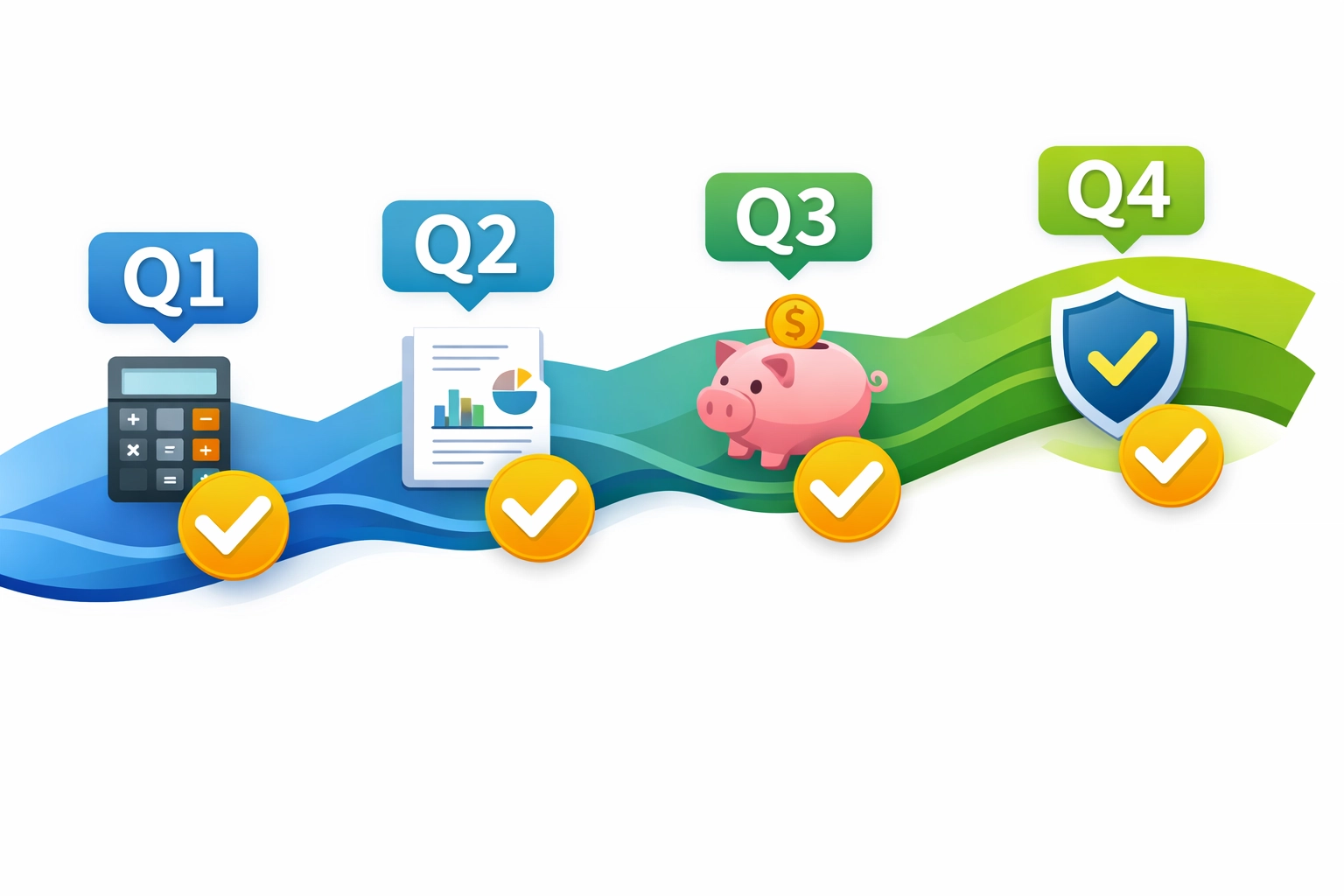
Strategy #2: Implement Quarterly Tax Planning to Avoid Penalties and Surprises!
Waiting until December to review your tax situation guarantees missed opportunities. Quarterly tax planning allows for real-time adjustments throughout the year.
Quarterly planning includes:
- Income and deduction projections every three months
- Withholding adjustments to match actual liability
- Estimated tax payment calculations to avoid underpayment penalties
- Strategic timing of income and expenses
This proactive approach prevents the common shock of owing thousands at filing time. More importantly, it identifies planning opportunities while you still have time to act. Notice your income spiked in Q2? Accelerate deductions in Q3. Expecting lower income next quarter? Delay certain income recognition if possible.
The IRS imposes penalties for underpayment of estimated taxes. These penalties compound quarterly and can add hundreds or thousands to your final tax bill. Quarterly planning eliminates this unnecessary expense.
Strategy #3: Optimize Investment Taxes Through Strategic Harvesting!
Investment gains create tax liability, but smart investors use strategic techniques to minimize that burden.
Tax-loss harvesting involves selling investments at a loss to offset capital gains. You can deduct up to $3,000 in net losses against ordinary income annually, with unlimited carryforward for future years. The key is maintaining your overall investment strategy while capturing tax benefits.
For tech professionals with equity compensation:
- Plan RSU (Restricted Stock Unit) vesting schedules to manage income spikes
- Time stock option exercises to minimize AMT (Alternative Minimum Tax) exposure
- Consider same-day sales versus hold strategies based on tax brackets
Investment tax optimization requires year-round attention. Review your portfolio quarterly. Identify opportunities for tax-loss harvesting before year-end. Coordinate equity compensation events with your overall tax strategy to avoid bracket creep.
Strategy #4: Maximize Real Estate Tax Benefits Through Depreciation Planning!
Real estate investors have access to powerful tax deductions that most people overlook. Depreciation allows you to deduct the cost of property over time, reducing taxable income without any cash outlay.
Key real estate strategies include:
- Accelerated depreciation through cost segregation studies
- Short-term rental classification (7 days or less average stay) to unlock unlimited loss deductions
- 1031 exchange coordination to defer capital gains taxes indefinitely
- Proper documentation of rental activities to qualify for real estate professional status
The difference between short-term and long-term rental treatment can save tens of thousands in taxes annually. Short-term rentals receive more favorable tax treatment, allowing losses to offset other income without passive activity limitations.
Planning 1031 exchanges requires advance preparation. You must identify replacement property within 45 days and close within 180 days. Miss these deadlines, and you lose the tax deferral entirely. A concierge tax advisor coordinates these timelines and ensures compliance with all requirements.
Strategy #5: Deploy Strategic Charitable Giving for Maximum Tax Impact!
Charitable donations reduce taxable income, but strategic giving amplifies the benefit significantly.
Donor-advised funds (DAFs) allow you to:
- Make a large contribution in high-income years for immediate tax deduction
- Distribute funds to charities over multiple years
- Invest the funds for potential growth before distribution
Bunching donations concentrates multiple years of giving into a single tax year. Instead of donating $10,000 annually, contribute $30,000 in year one and nothing in years two and three. This strategy works when bunching pushes you over the standard deduction threshold, creating itemization opportunities.
Donating appreciated securities provides a double benefit:
- Avoid capital gains tax on appreciation
- Deduct full fair market value of the donated asset
For example, stock purchased for $5,000 now worth $15,000 generates a $15,000 deduction without triggering $10,000 in capital gains. This beats selling the stock and donating cash by a significant margin.

Strategy #6: Choose and Optimize Your Business Entity Structure!
The business entity you select determines your tax treatment. Sole proprietorships, partnerships, S-corporations, and C-corporations each carry different tax implications.
Entity selection factors include:
- Current and projected income levels
- Number of owners and profit-sharing arrangements
- Fringe benefit needs (health insurance, retirement plans)
- State tax considerations
- Exit strategy and succession planning
Many business owners select an entity structure at formation and never revisit it. This is a costly mistake. Your optimal structure changes as your business grows and circumstances evolve.
Review your entity structure when:
- Annual revenue exceeds $75,000
- You add partners or shareholders
- State tax laws change
- You plan significant capital investments
- Retirement planning becomes a priority
S-corporation elections can be made retroactively in some cases, but timing requirements are strict. C-corporations benefit from the 21% flat tax rate on retained earnings. Sole proprietors may qualify for the 20% Qualified Business Income (QBI) deduction with proper structuring.
Each structure requires specific compliance and documentation. Failure to maintain proper corporate formalities can void your entity protection and tax benefits.
Strategy #7: Conduct Comprehensive Year-End Tax Planning Reviews!
December tax planning is not optional for serious tax savers. A comprehensive year-end review verifies accuracy of prior transactions and identifies last-minute planning opportunities.
Year-end review checklist includes:
- Income recognition timing (defer or accelerate based on next year's projections)
- Expense acceleration (equipment purchases, prepayments, bonuses)
- Retirement contribution maximization (401(k), SEP-IRA, defined benefit plans)
- Capital asset disposition timing
- Gift tax annual exclusion utilization ($18,000 per recipient in 2024)
Many tax strategies must be implemented before December 31st to affect current-year returns. Retirement plans have different deadlines: some extend to tax filing deadline plus extensions, while others require December 31st funding.
The review also catches errors before they become problems. Missed estimated payments can be corrected with fourth-quarter catch-up payments. Classification errors can be adjusted while documentation is fresh.
Stop Leaving Money on the Table!
These seven strategies represent standard practice in concierge tax planning. While they may seem complex, professional guidance makes implementation straightforward. The cost of professional tax planning typically returns 10-15 times its fee through tax savings and avoided penalties.
Tax laws change annually. New opportunities emerge while others phase out. Staying current requires continuous education and monitoring. Most taxpayers lack the time and expertise to track these changes effectively.
At Jose's Tax Service, we implement these strategies year-round for our clients. Our concierge approach means you always have a tax professional monitoring your situation and identifying opportunities. No more surprises at filing time. No more overpayment.
Ready to stop overpaying taxes? Contact us today to schedule your comprehensive tax planning consultation. We serve New Haven and surrounding areas with both in-person and virtual options available.
Visit josestaxservice.com or call to get started with concierge tax planning that puts money back where it belongs( in your wallet.)

Leave a Reply
You must be logged in to post a comment.