
Small Business Tax Services Explained in Under 3 Minutes: QBI Deduction, Bonus Depreciation, and Section 179 Updates
New Haven, CT – December 26, 2025 – Small business owners face three critical tax provisions that can dramatically impact your 2025 tax liability. Understanding the Qualified Business Income (QBI) deduction, Bonus Depreciation rules, and Section 179 updates will determine whether you maximize savings or leave thousands on the table.
QBI Deduction: Your 20% Small Business Tax Break!
The Qualified Business Income (QBI) deduction allows eligible small business owners to deduct up to 20% of qualified business income from personal taxes. This Section 199A deduction has been made permanent and no longer expires after 2025.
Who Qualifies for QBI?
You qualify if your total taxable income falls below these 2025 thresholds:
- $197,300 for single filers
- $394,600 for married filing jointly
Important: Income thresholds adjust annually for inflation starting in 2026. The deduction applies whether you itemize deductions or take the standard deduction.
QBI Phase-In Rules You Must Know!
If your income exceeds the base threshold but remains under the upper limits, you enter a phase-in range:
- Single filers: $197,300 to $247,300
- Joint filers: $394,600 to $494,600
During this phase-in range, your deduction gradually reduces. For specified service businesses (consulting, professional services, law, accounting), the deduction becomes completely unavailable once you exceed the upper threshold.

Complex Wage and Property Restrictions
For higher-income business owners, the deduction faces additional limitations. Your QBI deduction cannot exceed the greater of:
- 50% of W-2 wages paid by your business, OR
- 25% of W-2 wages plus 2.5% of qualified property's original cost
Warning: These calculations can become complex. Incorrect applications may lead to penalties and audit triggers.
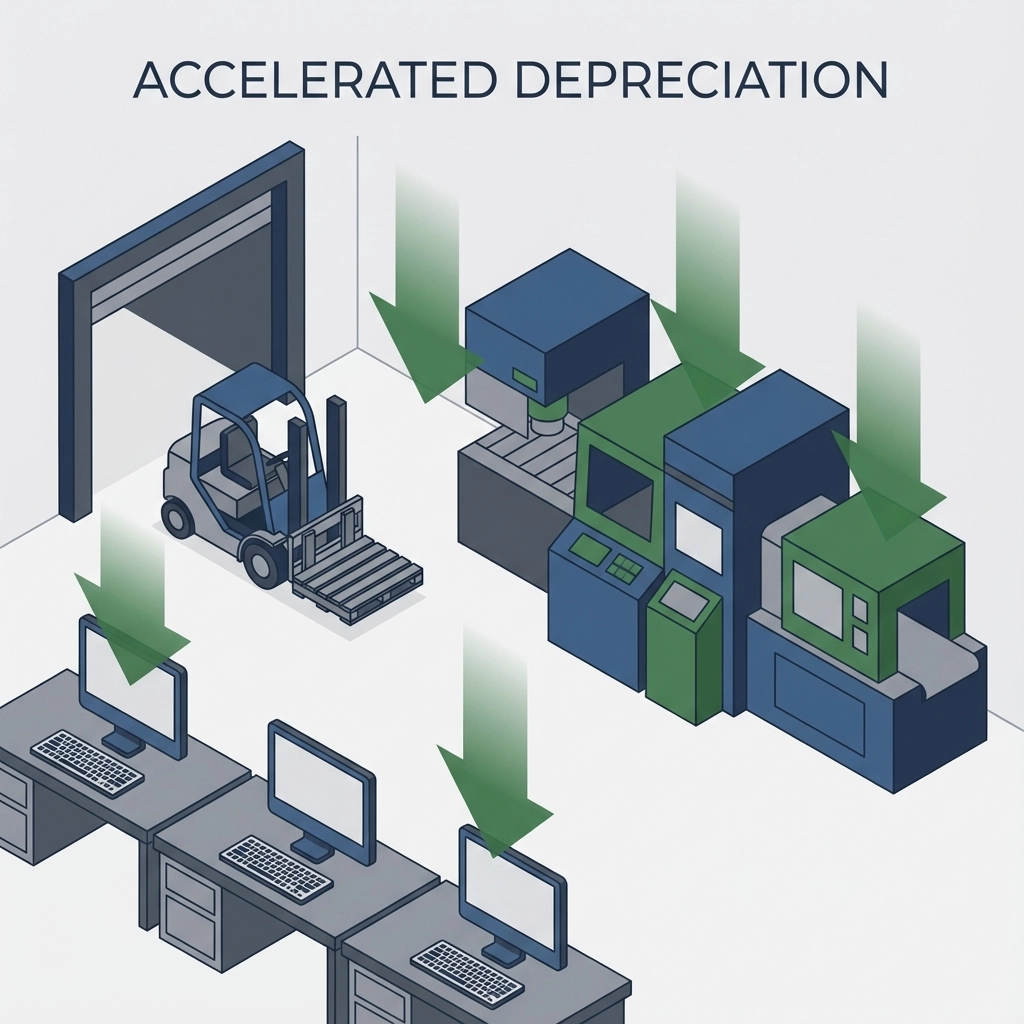
Bonus Depreciation: Accelerated Asset Write-Offs!
Bonus depreciation allows businesses to immediately deduct a significant percentage of qualifying asset costs in the first year of service, rather than spreading deductions over multiple years.
2025 Bonus Depreciation Rates
The Tax Cuts and Jobs Act bonus depreciation phases down according to this schedule:
- 2023: 80% immediate deduction
- 2024: 60% immediate deduction
- 2025: 40% immediate deduction
- 2026: 20% immediate deduction
- 2027 and beyond: 0% (expires)
Qualifying Assets for Bonus Depreciation
Eligible property includes:
- New and used equipment with recovery periods of 20 years or less
- Computer software
- Water utility property
- Qualified improvement property
- Certain film and television productions
Critical Deadline: Assets must be placed in service by December 31, 2025, to qualify for the 40% deduction rate.
Strategic Timing Considerations
Smart business owners should evaluate whether to claim bonus depreciation or elect out in favor of regular depreciation schedules. Factors include:
- Current year income levels
- Expected future tax rates
- Cash flow requirements
- Alternative Minimum Tax implications
Section 179: Immediate Equipment Expensing Updates!
Section 179 allows businesses to immediately expense the full cost of qualifying equipment purchases, rather than depreciating them over time.
2025 Section 179 Limits
For tax year 2025, Section 179 limits include:
- Maximum deduction: $1,160,000
- Investment threshold: $2,890,000
Phase-out rule: Your Section 179 deduction reduces dollar-for-dollar once total equipment purchases exceed $2,890,000. The deduction completely phases out at $4,050,000 in qualifying purchases.
Section 179 vs. Bonus Depreciation: Choose Wisely!
You cannot claim both Section 179 and bonus depreciation on the same asset. Consider these factors:
Choose Section 179 when:
- You need maximum current-year deduction
- Your business income exceeds the asset cost
- You want simplicity in calculations
Choose Bonus Depreciation when:
- Asset costs exceed Section 179 limits
- You have insufficient business income for Section 179
- You're purchasing used equipment

Qualifying Section 179 Property
Eligible assets include:
- Machinery and equipment
- Office furniture and computers
- Business vehicles (with restrictions)
- Software purchases
- Qualified real property improvements
Important limitation: Your Section 179 deduction cannot exceed your business's taxable income for the year. Excess amounts carry forward to future years.
Action Steps for Small Business Owners!
Before December 31, 2025:
- Calculate your projected 2025 income to determine QBI eligibility
- Review planned equipment purchases for bonus depreciation timing
- Evaluate Section 179 elections against current business income
- Document all qualifying expenditures with proper receipts and invoices
- Consider timing of income and expenses to optimize tax benefits
Required Documentation:
- Purchase invoices showing acquisition dates
- Asset placement-in-service dates
- Business use percentages for mixed-use assets
- Depreciation elections and calculations
- Form 4562 (Depreciation and Amortization)
Critical Warning: Improper depreciation elections can delay processing and trigger IRS audits. Documentation errors may result in disallowed deductions and penalty assessments.
Professional Tax Planning Considerations!
These provisions interact with other tax rules in complex ways. Consider professional consultation when:
- Your income approaches QBI phase-out thresholds
- You're making significant equipment purchases
- Your business structure affects deduction eligibility
- You operate multiple business entities
- You're considering entity conversions
Year-end planning deadline: December 31, 2025, represents the final opportunity to implement strategies affecting your 2025 tax liability.
Next Steps: Maximize Your 2025 Tax Benefits
Understanding QBI deductions, bonus depreciation, and Section 179 updates requires careful analysis of your specific business situation. These provisions can deliver substantial tax savings when properly applied.
Schedule your tax planning consultation before year-end to ensure you're maximizing all available deductions. Professional guidance helps navigate complex calculations and avoid costly mistakes.
For comprehensive small business tax services and year-end planning assistance, contact Jose's Tax Service to review your specific situation and implement optimal tax strategies before the December 31 deadline.

Leave a Reply
You must be logged in to post a comment.