
Maximize Your Tax Refund in 2026: The One Thing Virtual Tax Preparers Check That DIY Software Misses Every Time
You've been doing your taxes yourself for years. You follow the prompts, answer the questions, and hit submit. The software says you're getting a refund, and you feel satisfied. But here's what you don't know: you might be leaving hundreds, or even thousands, of dollars on the table.
DIY tax software is convenient, but it has a fundamental limitation. It can only work with what you tell it. A virtual tax preparer? They dig deeper. They ask the questions the software never thinks to ask.
The Critical Difference: Your Life Story vs. Data Entry
Tax software operates on a simple principle: you enter data, it calculates results. It asks you standard questions based on the most common scenarios. Did you buy a house? Check. Did you have a child? Check. Do you have student loans? Check.
But here's the problem. Your life doesn't fit neatly into checkboxes.
Virtual tax preparers check your entire financial life story. They review your previous returns, analyze your current situation, and identify opportunities the software's algorithm never considers. They look at how different aspects of your financial life interact, and that's where the real money is.
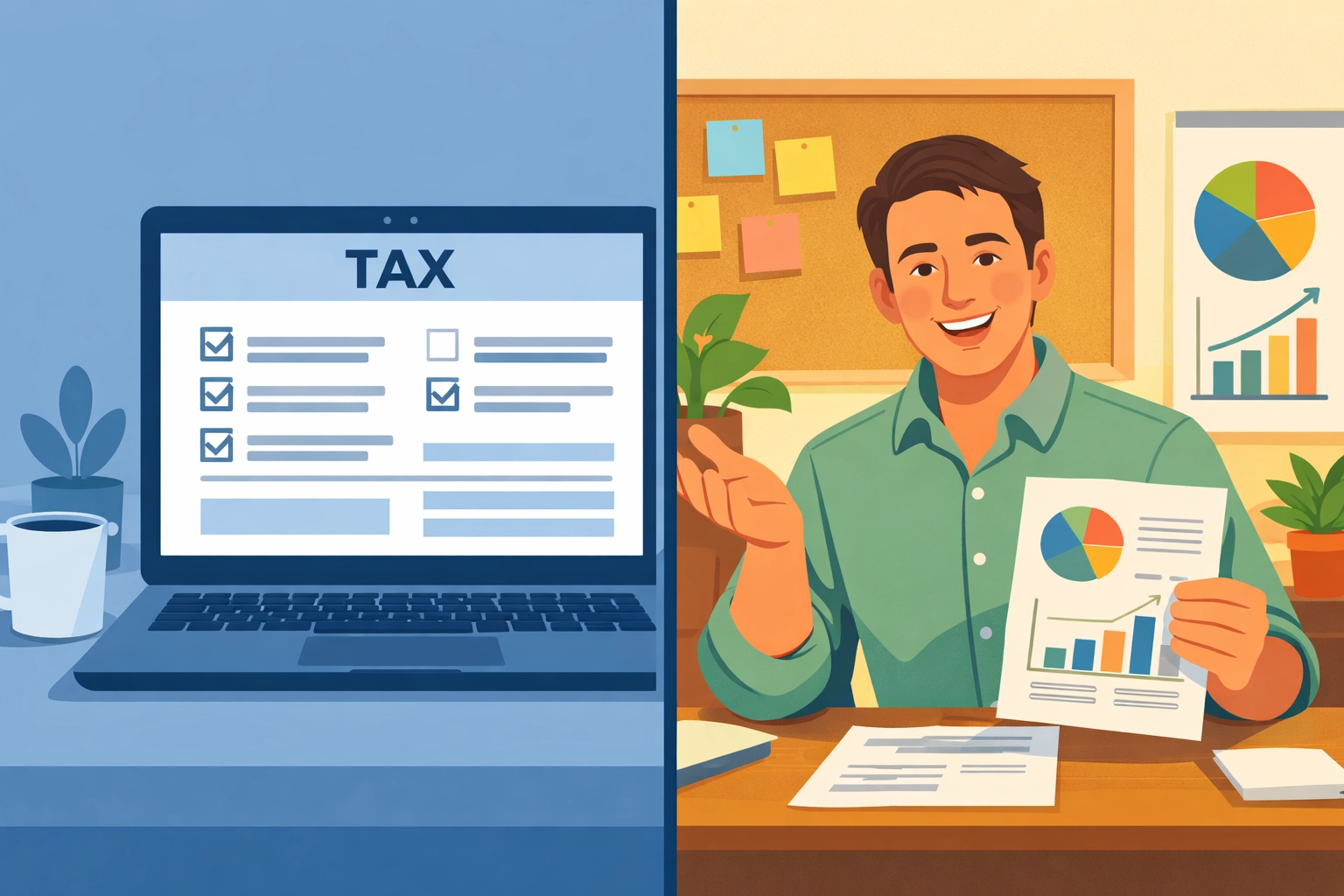
What Software Misses: The Context Behind Your Numbers
A virtual tax preparer at Jose's Tax Service doesn't just process your W-2. They conduct a comprehensive financial interview. They ask about:
- Life changes throughout the year (marriage, divorce, births, deaths)
- Job transitions or unemployment periods
- Side gigs or freelance work you might not consider "real" income
- Home office usage that increased due to remote work
- Medical expenses you paid out of pocket
- Educational expenses for yourself or dependents
- Charitable contributions beyond just cash donations
- State-to-state moves that affect your filing requirements
- Retirement account contributions made at different times
- Investment losses that can offset gains
Software asks about these items individually. A professional tax preparer connects the dots between them.
The One Thing: Strategic Filing Status Optimization
Here's the secret sauce. Virtual tax preparers analyze your filing status options in context with your complete financial picture. This isn't just about checking if you're married or single. It's about determining which filing status actually maximizes your refund based on your specific circumstances.
DIY software typically defaults to the most obvious filing status. You're married? It suggests Married Filing Jointly. You're single with a kid? It goes to Head of Household. Done.
But a tax professional digs deeper:
For married couples: Should you file jointly or separately? Software assumes jointly is always better, but that's not true if one spouse has significant medical expenses, student loan payments, or business losses. A virtual tax preparer runs the numbers both ways.
For divorced or separated individuals: Are you legally separated or just living apart? The IRS has specific rules about what qualifies as "unmarried" for tax purposes. Many people miss Head of Household status because they don't understand these nuances.
For those supporting relatives: Do you qualify for Head of Household status even without children? Software rarely catches qualifying relatives who don't live with you but whom you support financially.

Real-World Example: The $3,200 Mistake
Let me share a real scenario from our New Haven office. A client came to us after using DIY software for three years. She was divorced, had two kids living with her most of the time, and paid for her elderly mother's nursing home care.
The software filed her as Head of Household based on her children. That's correct, but incomplete.
Our virtual tax preparer discovered:
- Her mother qualified as a dependent based on the support test
- This opened eligibility for additional medical expense deductions
- Her ex-husband had been claiming one child, but their custody agreement didn't match the IRS time-sharing rules
- She actually qualified for the Earned Income Credit (EIC), which the software calculated incorrectly
The result? We amended her previous two years' returns and increased her current year refund by $3,200. The software got it "right" technically, but missed thousands in legitimate refunds.
Why Software Can't Replicate Human Analysis
Tax software is built on decision trees. If A, then B. If C, then D. It's algorithmic and predictable.
Human tax preparers use professional judgment. They recognize patterns, spot inconsistencies, and ask follow-up questions. They can say, "Wait, you mentioned you worked from home. Let's talk about your home office deduction. You also said you paid for internet and your phone? Let's calculate the business-use percentage."
Software asks about home office deductions, but it doesn't connect that question to your internet bill, your increased electricity costs, or the furniture you bought for your workspace.
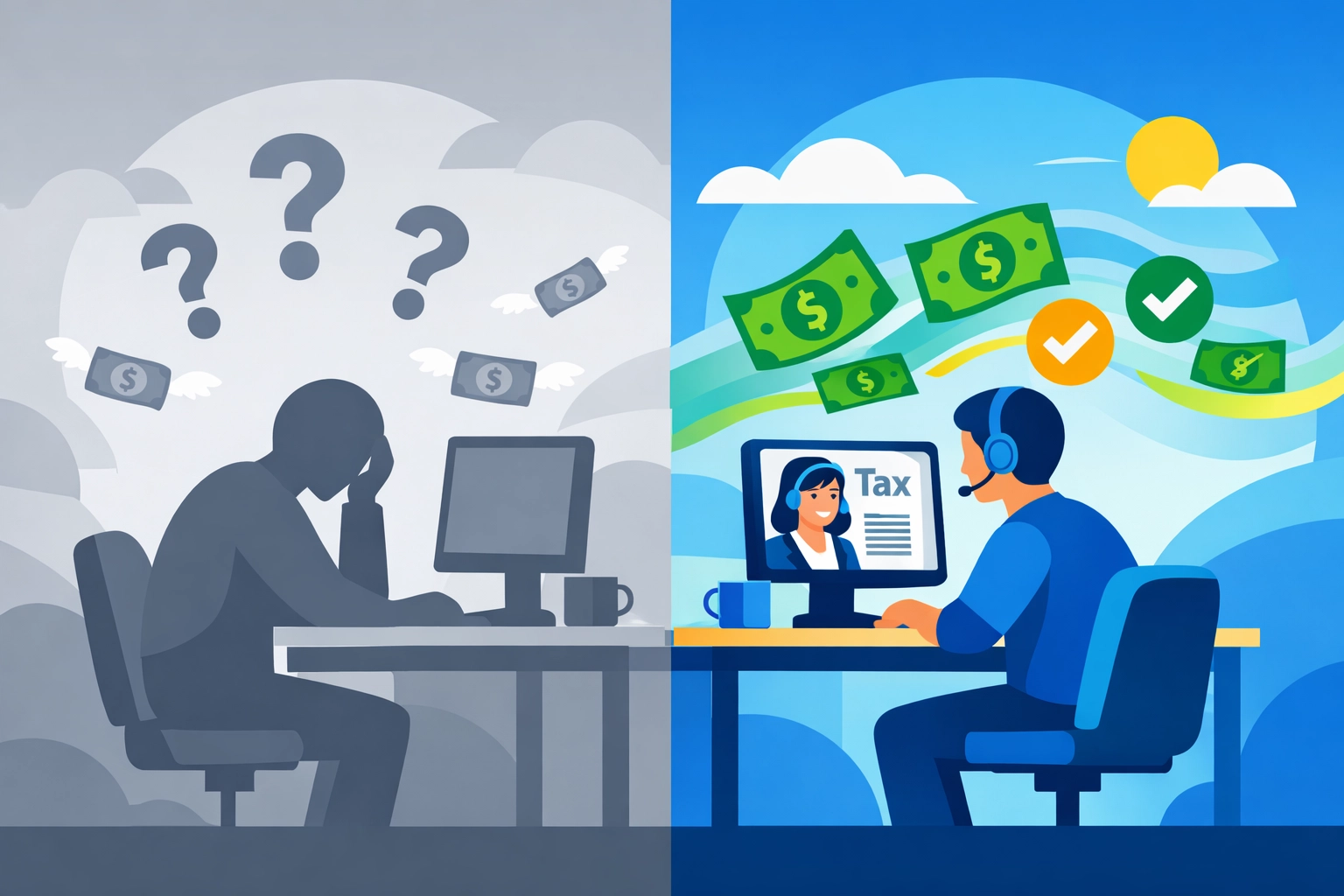
The Credits and Deductions Software Routinely Misses
Based on our experience with clients transitioning from DIY software to professional preparation, these are the most commonly missed opportunities:
Earned Income Credit (EIC): Software calculates this, but often incorrectly for self-employed individuals or those with investment income. The eligibility rules are complex, and small errors in reporting can disqualify you or reduce your credit amount.
Education Credits: Software asks if you paid tuition. It doesn't ask about required fees, books, or equipment that may qualify. It also doesn't optimize between the American Opportunity Credit and Lifetime Learning Credit based on your multi-year education plan.
Retirement Contribution Deductions: You can make IRA contributions up until the tax filing deadline for the previous year. Software doesn't prompt you to make these strategic contributions before filing. A virtual tax preparer calculates your optimal contribution amount and encourages you to maximize it before submitting your return.
State Tax Optimization: If you moved between states or worked in multiple states, software handles this mechanically. Tax professionals ensure you're not paying double tax and that you're claiming all available credits for taxes paid to other states.
Self-Employment Deductions: Software provides categories. Tax preparers know which expenses qualify in each category and how to maximize deductions while staying audit-proof.
The Virtual Advantage: Professional Expertise Without the Commute
Here's where it gets even better. Virtual tax preparation gives you access to professional expertise without geographic limitations. You don't need to search for "tax preparer near me" and hope you find someone good in your neighborhood.
At Jose's Tax Service, our virtual concierge tax preparation means:
- Secure document upload from anywhere
- Video consultations that replicate in-person meetings
- Real-time communication throughout the tax season
- Access to experienced professionals who specialize in complex situations
- Multi-year tax planning, not just annual filing
You get the personalized attention of a local tax office with the convenience of digital service.
What to Do Right Now
If you've been using DIY software and you're in one of these situations, you're likely leaving money on the table:
- You're self-employed or have a side business
- You went through a major life change (marriage, divorce, baby, death in family)
- You have investment income or sold stocks
- You moved between states or worked remotely for an out-of-state employer
- You support relatives financially
- You have significant medical expenses
- Your income varies significantly year to year
Action step: Review your last tax return. Look at your filing status, your credits, and your deductions. Then ask yourself: did anyone actually review my complete financial situation, or did I just answer questions in software?
The Bottom Line
DIY software is a calculator. It processes what you input. A virtual tax preparer is an advisor. They analyze your complete financial picture, identify opportunities you didn't know existed, and optimize your return strategically.
The one thing they check that software misses? Everything. They check how your filing status interacts with your life situation. They check how your deductions relate to your credits. They check if you're positioned optimally for this year and future years.
At Jose's Tax Service, we've seen it repeatedly. Clients who switch from DIY software to professional preparation typically see refund increases of $500 to $3,000 in their first year: just from catching what the software missed.
Ready to maximize your 2026 tax refund? Schedule a virtual consultation with our team. We'll review your situation, identify missed opportunities, and show you exactly how much more you could be getting back.
Don't leave money on the table. Let a professional review what the software never sees.
Jose's Tax Service provides virtual and concierge tax preparation services throughout New Haven and nationwide. Contact us for a free consultation on your 2026 tax strategy.

Leave a Reply
You must be logged in to post a comment.