
Maximize Your Tax Refund: 7 Mistakes New Haven Taxpayers Make (And How to Fix Them)
Tax season 2026 is here, and New Haven taxpayers are leaving thousands of dollars on the table. Every year, well-intentioned filers make preventable errors that shrink their refunds or trigger IRS delays. The good news? Most of these mistakes can be fixed with proper planning and professional guidance.
If you're filing your 2025 tax return this season, understanding these seven common errors will help you maximize your tax refund and avoid penalties. Here's what you need to know.
Mistake #1: Not Adjusting Your Withholding After Major Tax Law Changes!
Many New Haven taxpayers received significantly larger refunds in early 2026 because tax laws changed, but their W-4 withholding forms remained outdated. The standard deduction increased to $15,750 for single filers and $31,500 for married couples filing jointly. If your employer continued withholding based on previous tax brackets, you essentially gave the IRS an interest-free loan throughout 2025.
How to Fix It: Review your paystub immediately. If you received a refund exceeding $3,000, you likely overpaid throughout the year. Submit an updated Form W-4 to your employer to adjust your withholding for 2026. This puts more money in your pocket each paycheck rather than waiting for a refund next year.
For self-employed individuals and small business owners, recalculate your quarterly estimated tax payments using the updated tax brackets and standard deductions. Failure to adjust may result in underpayment penalties.
Mistake #2: Missing the Increased SALT Deduction Cap!
The state and local tax (SALT) deduction cap increased from $10,000 to $40,000 for 2025 tax returns. This represents a massive opportunity for New Haven homeowners and high-income earners who previously hit the old limit. Many taxpayers using DIY software or outdated information are still calculating their deductions based on the $10,000 cap.
How to Fix It: Gather all documentation for state income taxes paid, local property taxes, and eligible vehicle taxes. Connecticut taxpayers who paid significant state income tax throughout 2025 should itemize rather than take the standard deduction if their total itemized deductions exceed the standard threshold.
This calculation requires careful analysis. A professional tax preparation New Haven expert can run both scenarios: itemized versus standard deduction: to determine which approach yields the maximum tax refund.
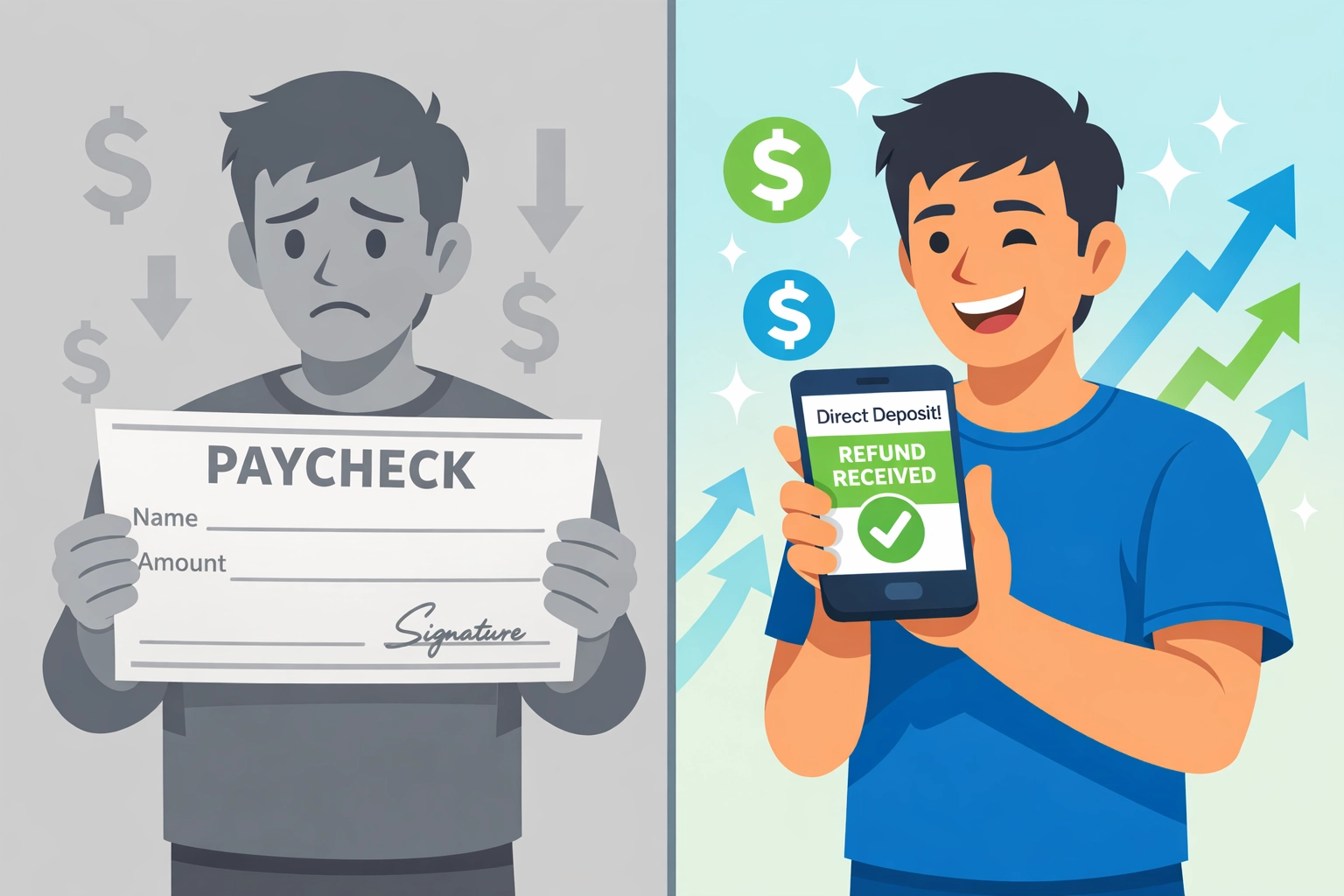
Mistake #3: Choosing Paper Check Refunds Instead of Direct Deposit!
The IRS has phased out most paper refund checks for 2026 processing. Taxpayers who request paper checks face delayed processing times, increased risk of lost or stolen checks, and potential identity verification requirements that further slow refunds.
How to Fix It: Provide accurate bank account information for direct deposit when filing your return. Direct deposit refunds process within 21 days for electronically filed returns, compared to 6-8 weeks for paper returns requesting paper checks.
Double-check account numbers and routing numbers before submitting. One transposed digit can delay your refund by weeks. If you don't have a traditional bank account, consider opening a basic checking account or using authorized prepaid debit cards that accept IRS direct deposits.

Mistake #4: Overlooking Qualified Business Income (QBI) Deductions for Side Hustles!
New Haven has seen explosive growth in gig economy work, freelancing, and side businesses. Many taxpayers with 1099-NEC income fail to claim the Qualified Business Income (QBI) deduction, which allows up to 20% of qualified business income to be deducted from taxable income.
How to Fix It: If you earned income from self-employment, consulting, freelancing, rental properties, or independent contracting, you may qualify for the QBI deduction. This deduction applies even if you take the standard deduction rather than itemizing.
Calculate your QBI carefully. Income thresholds and business type restrictions apply. For 2025 tax returns, the phase-out begins at $197,300 for single filers and $394,600 for married filing jointly. Professional guidance ensures you claim the maximum allowable deduction without triggering audit flags.
Maintain detailed records of all business expenses, including home office deductions, vehicle mileage, equipment purchases, and professional services. These expenses reduce your net self-employment income and lower your self-employment tax liability.
Mistake #5: Forgetting to Report Cryptocurrency Transactions and Digital Assets!
The IRS increased enforcement of cryptocurrency reporting requirements for 2025 tax returns. Every taxpayer must answer the digital asset question on Form 1040. Failing to report crypto sales, trades, staking rewards, or mining income can result in accuracy-related penalties of 20% or more.
How to Fix It: Compile complete records of all cryptocurrency transactions throughout 2025. This includes purchases, sales, exchanges between different cryptocurrencies, rewards, airdrops, and payments received in crypto.
Use the specific identification method to minimize capital gains tax when selling crypto assets. This allows you to choose which specific coins to sell, potentially selecting those with higher cost basis to reduce taxable gains.
If you used multiple exchanges or wallets, consolidate all transaction data before filing. Professional tax preparation New Haven services can import transaction data directly from major exchanges and calculate accurate gain/loss reporting for Schedule D and Form 8949.

Mistake #6: Claiming Ineligible Dependents or Missing Valuable Tax Credits!
Dependency rules changed for 2025, and many taxpayers claim dependents without meeting all qualifying criteria. Incorrect dependent claims trigger automatic IRS review and delay refunds. Conversely, eligible taxpayers miss valuable credits like the Child Tax Credit (CTC), Earned Income Tax Credit (EITC), and education credits.
How to Fix It: Verify that each dependent meets all five tests: relationship, age, residency, support, and joint return. For divorced or separated parents, confirm who has the right to claim children based on custody agreements and IRS tiebreaker rules.
Review credit eligibility carefully. The CTC provides up to $2,000 per qualifying child under age 17. The EITC offers substantial refunds for lower and middle-income workers, with amounts varying based on income and number of children. The American Opportunity Tax Credit (AOTC) and Lifetime Learning Credit provide education expense relief for eligible students.
Many New Haven families leave thousands of dollars unclaimed because they don't realize they qualify for these credits. A concierge tax pro reviews your complete financial picture to identify every credit and deduction available.
Mistake #7: Filing Without Professional Review in Complex Tax Situations!
DIY tax software works well for simple W-2 returns with standard deductions. However, complex situations: multiple income sources, business ownership, investment properties, divorce or separation, retirement account distributions, stock options, or significant life changes: require professional expertise to maximize your tax refund and ensure compliance.
How to Fix It: Schedule a consultation with an experienced tax professional before filing. At Jose's Tax Service, our concierge tax preparation approach means we handle every detail of your return while you focus on your business and family.
We review prior year returns to identify missed opportunities, analyze your complete financial situation, implement tax planning strategies for current and future years, and provide year-round support for tax questions. Our expertise ensures you pay the minimum tax required by law while avoiding costly mistakes that trigger audits or penalties.
Filing errors, missed deductions, and incomplete documentation cost taxpayers an average of $2,400 per return according to recent IRS data. Professional preparation pays for itself through increased refunds and peace of mind.
The Concierge Advantage: How Jose's Tax Service Maximizes Your Refund
Tax preparation shouldn't feel overwhelming. Our concierge tax pro service eliminates stress and maximizes results through personalized attention and expert guidance. We serve New Haven individuals, families, and small businesses with comprehensive tax solutions.
What sets our concierge approach apart:
Personalized service: You work directly with Jose Morales, not a rotating team of seasonal preparers. Your tax pro knows your financial situation and builds strategies around your goals.
Proactive planning: We don't just prepare returns: we plan ahead. Quarterly check-ins, estimated tax calculations, and strategic advice keep you on track year-round.
Maximum refund guarantee: Our expertise identifies every deduction, credit, and strategy to minimize tax liability and maximize refunds.
Audit protection: If questions arise, we handle IRS correspondence and represent you throughout the process.
The 2026 tax season presents unique opportunities and challenges. Don't leave money on the table or risk penalties from preventable errors. Contact Jose's Tax Service today to schedule your concierge tax preparation consultation.
Visit josestaxservice.com or call our New Haven office to get started. Your maximum refund is waiting.

Leave a Reply
You must be logged in to post a comment.