
The Ultimate Guide to Tax Planning: Everything You Need to Maximize Your Tax Refund in 2026
NEW HAVEN, CT : Jose's Tax Service : March 25, 2026
The 2026 tax landscape has shifted significantly, presenting both new challenges and unprecedented opportunities for taxpayers in New Haven. With recent legislative updates taking full effect, filers are projected to see a $1,000 average increase in refunds or a lower balance due compared to previous cycles. However, achieving these results requires more than just reactive filing; it demands proactive, year-round tax planning.
At Jose's Tax Service, we recognize that tax laws are complex. This guide provides the technical framework necessary to navigate the 2026 requirements, optimize your financial position, and ensure you maximize your tax refund through strategic action.
2026 Tax Update: Navigating the New Law
The current tax year introduces pivotal changes to the Internal Revenue Code (IRC) that directly impact your bottom line. Understanding these shifts is the first step in effective tax preparation in New Haven.
Key Changes to the SALT Cap
For several years, the State and Local Tax (SALT) deduction was capped at $10,000, which heavily penalized homeowners in high-tax states like Connecticut. In 2026, the SALT cap has been adjusted upward, allowing New Haven residents to deduct a larger portion of their state income taxes and local property taxes. This change alone can significantly reduce taxable income for those who itemize.
New Deductions for the Modern Workforce
The 2026 tax law introduces specific deductions for overtime pay and tips, as well as renewed allowances for unreimbursed work-related expenses. These provisions are designed to provide relief to hourly workers and service industry professionals. To claim these, you must maintain rigorous documentation, including:
- Employer-provided overtime statements.
- Daily tip logs (Form 4070-A).
- Receipts for work-related uniforms, tools, or professional dues.

Strategic Retirement and Savings Contributions
One of the most effective methods to lower your tax liability is the utilization of tax-advantaged accounts. Every dollar contributed to a traditional retirement account reduces your Adjusted Gross Income (AGI) on a dollar-for-dollar basis.
401(k) and IRA Limits
For 2026, the IRS has increased contribution limits for employer-sponsored 401(k) plans and Individual Retirement Accounts (IRAs).
- Traditional 401(k): Contributing to this plan lowers your current taxable income.
- IRA Contributions: If you do not have an employer plan, or if your income falls within certain limits, your IRA contributions may be fully deductible.
Research indicates that every $25 reduction in taxable income lowers your tax bill by approximately $5, depending on your bracket. To see how these contributions affect your specific situation, you can use our Tax Quote Tool to estimate your potential savings.
Health Savings Accounts (HSAs)
If you are enrolled in a High-Deductible Health Plan (HDHP), an HSA is a powerful tax-planning tool.
- Contributions are tax-deductible: Deposits reduce your taxable income.
- Growth is tax-deferred: Earnings on the account are not taxed.
- Withdrawals are tax-free: As long as funds are used for qualified medical expenses, they are never taxed.
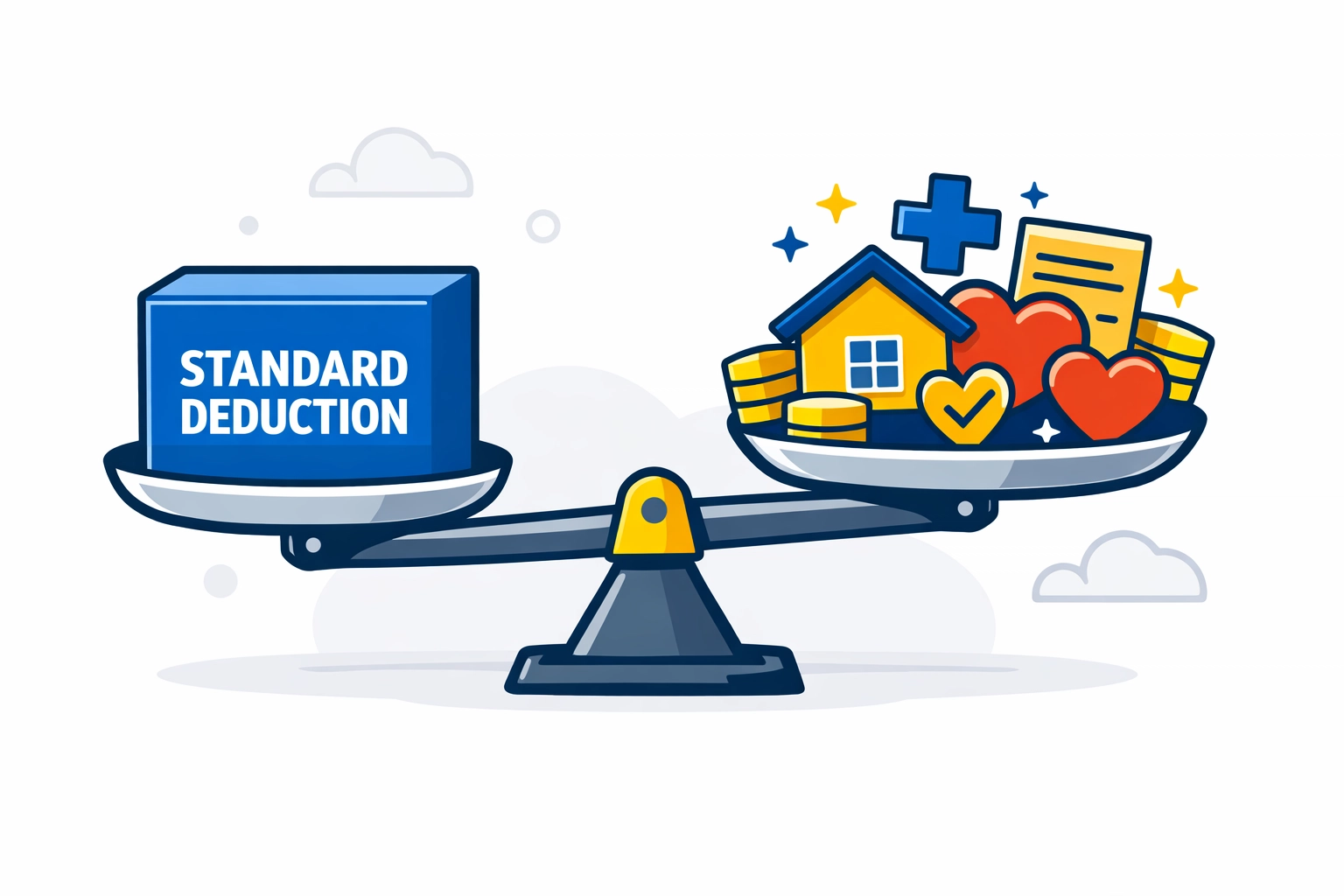
Mastering Deductions: Itemizing vs. Standard Deduction
The decision to itemize or take the standard deduction is critical. While the standard deduction remains elevated in 2026, the changes to the SALT cap and mortgage interest rules may make itemizing more beneficial for New Haven property owners.
The "Bunching" Strategy
"Bunching" is a strategy where a taxpayer concentrates deductible expenses into a single tax year to exceed the standard deduction threshold. This is often applied to:
- Charitable Donations: Consolidating two years of giving into one.
- Medical Expenses: Scheduling elective procedures in the same year to meet the AGI percentage threshold.
- Property Taxes: Paying the January installment in December (if permitted by local law).
Qualified Business Income (QBI) Deduction
Small business owners and freelancers in New Haven should prioritize the Qualified Business Income (QBI) deduction. Under Section 199A, eligible self-employed individuals can deduct up to 20% of their qualified business income from their taxes. This deduction is taken in addition to standard business expenses.
Leveraging 2026 Tax Credits
Unlike deductions, which lower the income you are taxed on, tax credits provide a dollar-for-dollar reduction of the actual tax you owe. This is the fastest way to maximize your tax refund.
Child Tax Credit (CTC)
Ensure you have updated Social Security numbers for all dependents. The 2026 credits are robust, but they require accurate filing of Schedule 8812. Failure to provide correct dependent information is a primary cause of refund delays.
The Saver’s Credit
Form 8880, the Credit for Qualified Retirement Savings Contributions, is often overlooked. Low-to-moderate-income earners who contribute to an IRA or 401(k) may receive a credit of up to 50% of their contribution. This effectively allows the government to "subsidize" your retirement savings.
Education and Energy Credits
- American Opportunity Tax Credit (AOTC): For the first four years of higher education.
- Lifetime Learning Credit (LLC): For graduate and professional degree courses.
- Residential Clean Energy Credit: If you installed solar panels or energy-efficient heat pumps in your New Haven home during 2025/2026, you may be eligible for a credit worth 30% of the cost.
Small Business and Side Hustle Compliance
If you operate a business in New Haven or have a side hustle involving platforms like Uber, Etsy, or Airbnb, 2026 brings stricter reporting requirements for 1099-K forms.
Managing 1099-K Thresholds
Payment processors are now required to report gross payments exceeding lower thresholds than in previous years. To avoid overpaying:
- Separate Personal and Business: Never mix personal transfers (like splitting a dinner bill) with business income.
- Track Every Expense: Use the JTS Tools to stay organized throughout the year.
- Deduct Marketing: All advertising, website hosting, and promotional materials are fully deductible business expenses.
Tax-Loss Harvesting
If you have investments in a taxable brokerage account, consider tax-loss harvesting. By selling underperforming assets at a loss, you can offset capital gains realized earlier in the year. If your losses exceed your gains, you can use up to $3,000 of the excess loss to offset your ordinary income.

Why a Concierge Tax Pro Wins in 2026
While DIY software is available, the complexity of the 2026 code makes professional oversight more valuable than ever. A concierge tax pro at Jose's Tax Service provides a level of scrutiny that software cannot replicate.
Personalized Strategy vs. Algorithms
Software follows a linear logic. A professional tax preparer looks at your entire financial ecosystem. We identify:
- Subtle "gray area" deductions specific to your industry.
- Compliance issues that could trigger an IRS audit.
- Opportunities for future year tax planning that software ignores.
If you are ready to move beyond basic filing and into strategic wealth preservation, you can start your tax journey with us here.
2026 Action Checklist: Don’t Leave Money on the Table
To ensure your filing process is seamless and your refund is maximized, follow these imperative steps:
- Gather Official Documents: Collect all W-2s, 1099s (NEC, MISC, K, INT), and 1098s (Mortgage Interest).
- Verify Dependent Info: Ensure all names and Social Security numbers match Social Security Administration records exactly.
- Calculate HSA and IRA Contributions: You have until the April filing deadline to make contributions for the 2025 tax year.
- Review Mileage Logs: If you claim vehicle expenses, ensure your logs include dates, destinations, and business purposes.
- Check for Underpayment: If you expect to owe, adjust your withholding immediately or make an estimated payment to avoid the Underpayment Penalty.
- Secure Your Data: Use our E-signing Portal and secure upload tools to protect your sensitive information.
Deadlines to Remember
- Estimated Tax Payments: Due quarterly (April 15, June 15, Sept 15, Jan 15).
- Final Filing Deadline: Wednesday, April 15, 2026.
- Extension Deadline: October 15, 2026 (Note: An extension to file is not an extension to pay).
For a comprehensive review of your documents, visit our Download Center for organizers and checklists.
Maximize your tax refund this year by making informed, strategic decisions. If you have questions about how the 2026 laws apply to your New Haven household or business, contact Jose' Morales or any of our expert staff today.
Categories: tax planning, news
Tags: New Haven, 1040, IRS, Tax Preparation New Haven, Maximize Tax Refund, Concierge Tax Pro, 2026 Tax Law, Small Business Deductions, Child Tax Credit.

Leave a Reply
You must be logged in to post a comment.