
The New Haven Taxpayer's Guide to the $40,000 SALT Deduction in 2026
New Haven, CT : January 2026 : Big news for Connecticut taxpayers. The State and Local Tax (SALT) deduction cap has increased significantly for the 2026 tax year. If you own property in New Haven or pay substantial state income taxes, this change could put real money back in your pocket.
Here's what you need to know about the new $40,400 SALT deduction cap and how to make it work for your 2026 tax return.
What Is the SALT Deduction?
The SALT deduction allows you to deduct certain state and local taxes from your federal taxable income. These taxes include:
- State income taxes (or sales taxes, if you choose)
- Local property taxes
- Real estate taxes
For years, the SALT deduction was capped at $10,000. That limit hit New Haven homeowners hard. Connecticut has some of the highest property taxes in the nation, and many residents found themselves unable to deduct all the state and local taxes they paid.
That changes in 2026.

The New $40,400 SALT Cap: What Changed?
Under the 2026 tax law, the SALT deduction cap rises to $40,400. That's a $30,400 increase from the previous $10,000 limit.
For New Haven taxpayers who itemize deductions, this is a significant opportunity. If your combined state income taxes and property taxes exceed $10,000: and for many Connecticut residents, they do: you can now deduct substantially more.
Key details about the 2026 SALT cap:
| Filing Status | Maximum SALT Deduction |
|---|---|
| Single | $40,400 |
| Married Filing Jointly | $40,400 |
| Married Filing Separately | $20,200 |
The cap increases by 1% each year through 2029. Plan accordingly.
Who Qualifies for the Full $40,400 Deduction?
Not everyone can claim the full amount. Eligibility depends on your Modified Adjusted Gross Income (MAGI).
To claim the full $40,400 deduction:
- Your MAGI must not exceed $505,000 (married filing jointly)
- Your MAGI must not exceed $250,000 (married filing separately)
- You must itemize your deductions on your federal return
If you take the standard deduction, you cannot claim the SALT deduction. Period.

Income Phase-Out Rules: Know the Limits
Here's where tax planning gets important. If your MAGI exceeds the threshold, your SALT deduction begins to shrink.
The phase-out formula:
For every dollar your MAGI exceeds $505,000, your maximum SALT deduction decreases by 30 cents.
Example calculation:
- MAGI: $560,000
- Amount over threshold: $60,000
- Reduction: $60,000 × $0.30 = $18,000
- Adjusted SALT cap: $40,400 − $18,000 = $22,400
By the time your MAGI reaches approximately $635,000, you're back to the old $10,000 cap.
Warning: Miscalculating your MAGI can lead to underpayment penalties. Double-check your income figures before filing.
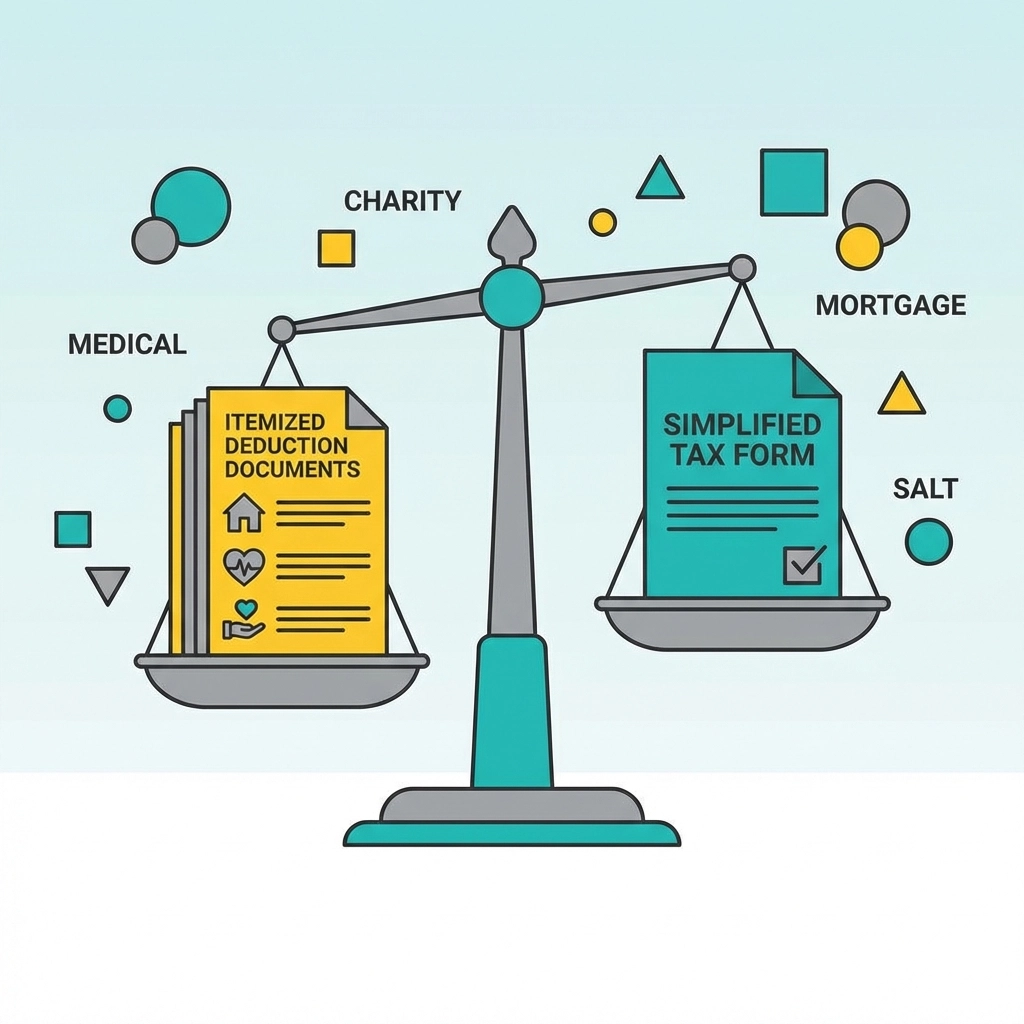
Should You Itemize or Take the Standard Deduction?
This is the critical question for 2026 tax planning.
The standard deduction for married couples filing jointly is approximately $31,500 in 2026. For single filers, it's roughly half that amount.
Itemize your deductions if:
- Your SALT payments alone approach or exceed the standard deduction
- You have significant mortgage interest
- You made substantial charitable contributions
- Your combined itemized deductions exceed the standard deduction amount
Take the standard deduction if:
- Your total itemized deductions fall below the standard deduction threshold
- You prefer simplicity and have minimal deductible expenses
For many New Haven homeowners paying $11,000 to $16,000 in property taxes annually, itemizing now makes financial sense. Add your Connecticut state income tax, and you may easily surpass the standard deduction.
Practical Steps to Maximize Your SALT Deduction in 2026
Follow these steps to ensure you capture every dollar of your SALT deduction:
Step 1: Gather Your Tax Documents
Collect the following before preparing your return:
- Property tax bills and payment receipts
- W-2 forms showing state income tax withheld
- Estimated tax payment records
- Form 1099 statements with state tax information
Step 2: Calculate Your Total SALT Payments
Add up all qualifying state and local taxes paid during 2026:
- Connecticut state income tax
- New Haven property taxes
- Any local taxes applicable to your situation
Step 3: Compare Itemized vs. Standard Deduction
Use Schedule A (Form 1040) to calculate your total itemized deductions. Compare this figure to your standard deduction amount. File using whichever method produces the lower tax liability.
Step 4: Review Your MAGI
Confirm your Modified Adjusted Gross Income falls within the threshold for the full SALT deduction. If you're close to the $505,000 limit, consider strategies to reduce your MAGI, such as maximizing retirement contributions.
Step 5: File Accurately and On Time
Enter your SALT deduction on Line 5d of Schedule A. Double-check all figures. Filing errors can delay processing and may trigger IRS inquiries.
Deadline reminder: The federal tax filing deadline for 2026 returns is April 15, 2027.
Strategic Tax Planning Considerations
The expanded SALT cap is temporary. It applies only through 2029 and reverts to $10,000 in 2030. Plan ahead.
Consider these strategies:
Bunching deductions: If you're near the itemization threshold, consider prepaying January 2027 property taxes in December 2026 to maximize your deduction in one tax year.
Timing income: If your MAGI is close to the phase-out threshold, deferring income or accelerating deductions may help you qualify for a larger SALT deduction.
Reviewing withholdings: Ensure your state tax withholdings align with your actual tax liability. Overpaying state taxes doesn't help if you can't deduct the excess.

What This Means for New Haven Residents
New Haven's property tax rates rank among the highest in Connecticut. The median property tax bill in the city often exceeds $8,000 annually. Add state income tax, and many residents easily surpass the old $10,000 cap.
With the new $40,400 limit, New Haven taxpayers can finally deduct what they actually pay. This levels the playing field with residents of lower-tax states.
Potential savings example:
A New Haven homeowner paying $12,000 in property taxes and $15,000 in state income taxes has $27,000 in SALT payments. Under the old rules, only $10,000 was deductible. Under the 2026 rules, the full $27,000 is deductible: assuming MAGI requirements are met.
At a 24% federal tax bracket, that's an additional $4,080 in tax savings.
Important Reminders
- The SALT deduction cap increases 1% annually through 2029
- This provision expires after 2029: plan for the reversion to $10,000
- You must itemize to claim the SALT deduction
- Keep detailed records of all state and local tax payments
- Consult a tax professional if your situation is complex
Get Professional Tax Preparation Help
Navigating the new SALT deduction rules can be complicated, especially if you're near the income thresholds or unsure whether to itemize. A qualified tax professional can help you maximize your deductions while staying compliant with 2026 tax law.
At Jose's Tax Service, we specialize in helping New Haven residents optimize their tax returns. Whether you need guidance on the SALT deduction, itemization strategies, or comprehensive tax preparation, we're here to help.
File smart. Keep more of your money. That's the goal.

Leave a Reply
You must be logged in to post a comment.