
7 Mistakes You’re Making with Small Business Marketing Deductions (And How to Fix Them for 2026)
DATELINE: NEW HAVEN, CT
ORGANIZATION: JOSE’S TAX SERVICE
DATE: MARCH 9, 2026
For small business owners in New Haven, marketing is the engine that drives growth. However, when tax season arrives, many entrepreneurs fail to correctly categorize these costs, leading to missed opportunities to maximize tax refund amounts or, worse, triggering an Internal Revenue Service (IRS) audit. As we navigate the 2026 tax year, understanding the nuances of the "ordinary and necessary" test is critical for maintaining compliance.
At Jose’s Tax Service, we see many business owners leave money on the table because they do not realize which promotional activities qualify as legitimate business expenses. Below are the seven most common mistakes businesses make regarding marketing deductions and the specific steps required to correct them for your 2026 filing.
1. Failing to Maintain Precise Documentation!
The most frequent error in tax preparation New Haven businesses face is the lack of a "paper trail." The IRS requires that every deduction be supported by evidence. Relying solely on credit card statements is insufficient because they often lack the detail necessary to prove the business nature of the expense.
The Fix:
- Maintain original invoices from advertising agencies, social media platforms (Meta, Google, LinkedIn), and print shops.
- Store digital copies of campaign reports that show the duration and intent of the advertisement.
- Use an organized bookkeeping system. If you are unsure how to start, visit our Bookkeeping Basics section for guidance.
- Archive documentation for at least three years from the date you file your return.

2. Confusing Marketing Expenses with Capital Improvements!
Under IRS guidelines, most marketing costs are deductible in the year they are incurred. However, certain long-term assets: such as a major website overhaul or the purchase of permanent signage: may be classified as capital improvements. These must often be depreciated over several years rather than deducted in full immediately.
The Fix:
- Identify if the expense provides a benefit that lasts significantly beyond the current tax year.
- Categorize routine maintenance of your website (hosting, plugin updates, minor content changes) as a current expense.
- Consult a concierge tax pro to determine if a large-scale branding project should be capitalized under current 2026 tax codes.
3. Neglecting the "Ordinary and Necessary" Test!
To be deductible, a marketing expense must be "ordinary": common and accepted in your industry: and "necessary": helpful and appropriate for your trade or business. Many New Haven business owners attempt to deduct "viral" marketing attempts or high-end lifestyle content that the IRS may deem unnecessary for their specific niche.
The Fix:
- Evaluate every promotional spend: Does this directly relate to generating revenue or brand awareness for my specific services?
- Document the business purpose of unconventional marketing. If you are a plumber sponsoring a local New Haven little league team, keep the sponsorship agreement to prove the community outreach and branding intent.
- File your returns with the understanding that the IRS does not require an expense to be "indispensable," but it must have a clear business logic.
4. Deducting Personal Branding Unrelated to the Business!
In the age of the "influencer," many business owners blur the line between personal lifestyle and business promotion. Expenses related to your personal appearance, non-business social outings, or personal travel that you attempt to frame as "content creation" are high-risk areas.
The Fix:
- Separate personal social media accounts from business accounts.
- Exclude costs for clothing, grooming, or personal hobbies unless they are strictly required for a specific, documented business promotion (e.g., a branded uniform).
- Review the Small Business Learning Center for more details on the boundary between personal and professional expenses.

5. Attempting to Deduct Political Advertising!
A common misconception is that any "publicity" is deductible. However, the IRS is very strict: expenses paid for political advertising or contributions to political campaigns are not deductible as business expenses. This includes advertisements in convention programs or tickets to political dinners, even if they are used for networking.
The Fix:
- Identify any payments made to political action committees (PACs) or for lobbying efforts.
- Reclassify these as non-deductible expenses in your ledger to ensure they do not accidentally end up on your Schedule C or corporate return.
- Double-check your local New Haven civic involvements to ensure they are categorized as "charitable" or "marketing," rather than "political."
6. Disguising Entertainment as Promotional Activity!
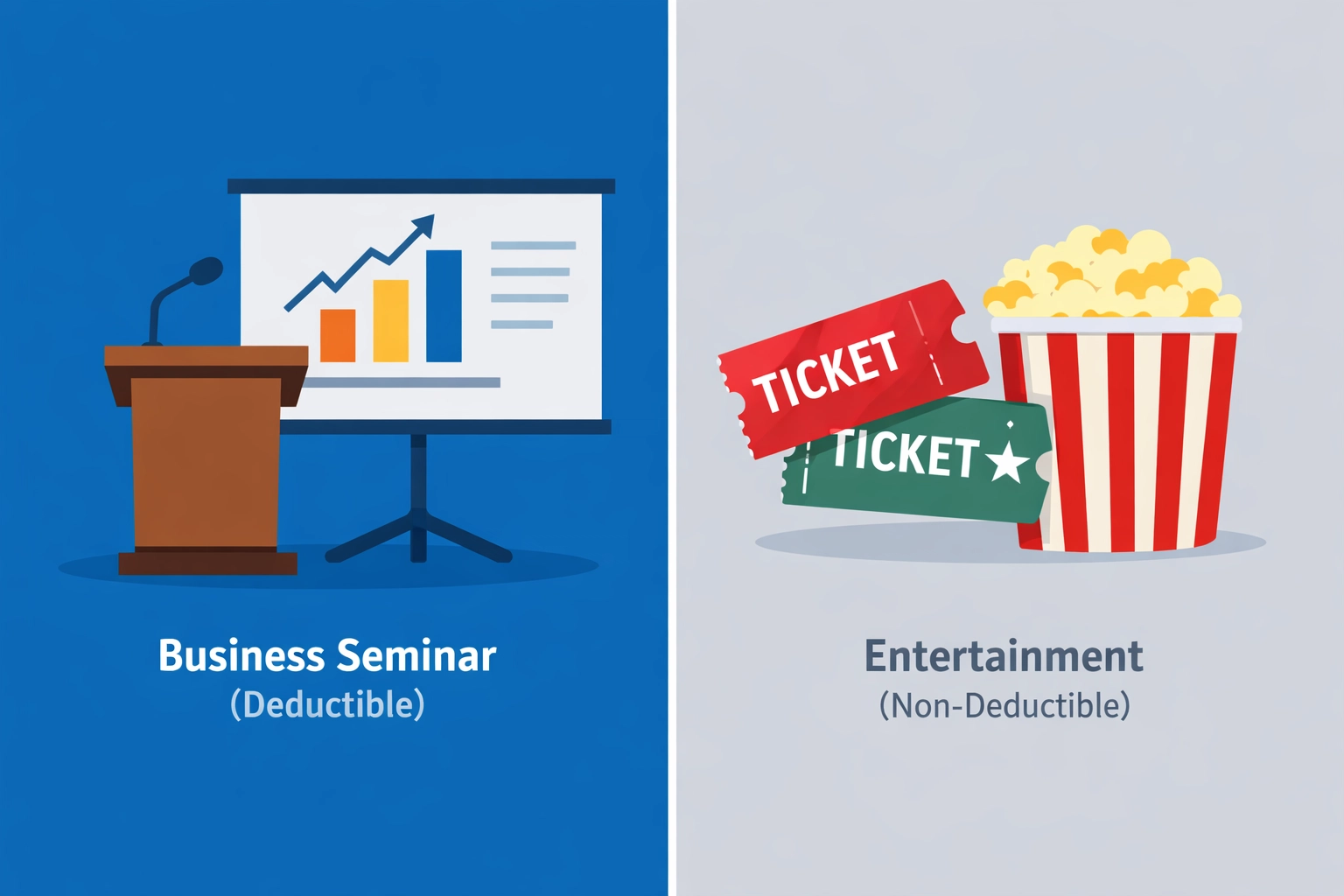
Following the Tax Cuts and Jobs Act (TCJA) and subsequent updates for 2026, most entertainment expenses are non-deductible. Many business owners try to circumvent this by calling a lavish dinner or a sporting event a "marketing event." If the primary purpose is entertainment rather than a presentation or a formal promotional activity, the IRS will likely disallow it.
The Fix:
- Distinguish between a "marketing event" (like a free seminar for clients) and an "entertainment event" (like taking a client to a New Haven Ravens game).
- Apply the 50% limit to meals that are genuinely associated with business marketing, and ensure you have a log of who attended and what business was discussed.
- Use the Contact Page to ask our team about the specific meal and entertainment rules for the 2026 tax year.
7. Forgetting to Track Campaign Effectiveness!
While the IRS doesn't explicitly require your marketing to be successful to be deductible, having records that connect your spending to business results provides a strong defense of the "necessary" part of the "ordinary and necessary" test. If you spend $10,000 on a billboard and have no record of it ever being placed or any strategy behind it, it may be viewed with suspicion.
The Fix:
- Link marketing invoices to specific campaigns.
- Record the duration of the campaign and the platforms used.
- Utilize a professional tax service to review your "Marketing and Advertising" line item. Excessive spending relative to gross receipts without a documented growth strategy is a red flag for an audit.
Step-by-Step Guide to Fixing Your Marketing Deductions for 2026
To ensure you are fully prepared for your next filing and to maximize tax refund opportunities, follow these instructional steps:
- Audit Your Current Ledger: Review your "Advertising" or "Marketing" category in your accounting software. Move any personal, political, or entertainment-heavy items to the appropriate non-deductible categories.
- Gather Your Receipts: Ensure every digital ad spend (Facebook, Google, etc.) has a corresponding PDF receipt stored in a dedicated "2026 Tax" folder.
- Verify Business Purpose: For any large or unusual marketing expense, write a brief memo (one or two sentences) explaining how it was intended to help the business.
- Schedule a Consultation: Don't wait until April. A concierge tax pro at Jose’s Tax Service can review your expenses mid-year to ensure you are on the right track. Schedule your tax appointment with ease today.
- Review New Haven Specific Credits: Sometimes local marketing initiatives in New Haven may qualify for specific state-level incentives. Check our About Us page to see how Jose' Morales and the team stay updated on Connecticut-specific tax law changes.

Final Reminder: 2026 Deadlines and Compliance
Marketing deductions are a powerful tool for reducing your taxable income, but they must be handled with the precision of a professional. Improperly claiming these deductions may lead to penalties, interest, and a significant delay in processing your return.
For personalized assistance and to ensure your small business is tax-ready, contact Jose’s Tax Service. We provide comprehensive tax preparation New Haven business owners can trust.
Practical Reminders:
- Quarterly Estimated Taxes: Remember that marketing expenses lower your net profit, which affects your quarterly estimated tax payments. Adjust your payments accordingly to avoid underpayment penalties.
- Form 1099-NEC: If you pay an independent contractor (like a freelance graphic designer) more than $600 for marketing services, you are generally required to issue them a Form 1099-NEC.
Contact Information:
Jose’s Tax Service
New Haven, CT
Request a Quote
Tax Preparation Service in New Haven
Tags: news, tax planning

Leave a Reply
You must be logged in to post a comment.